
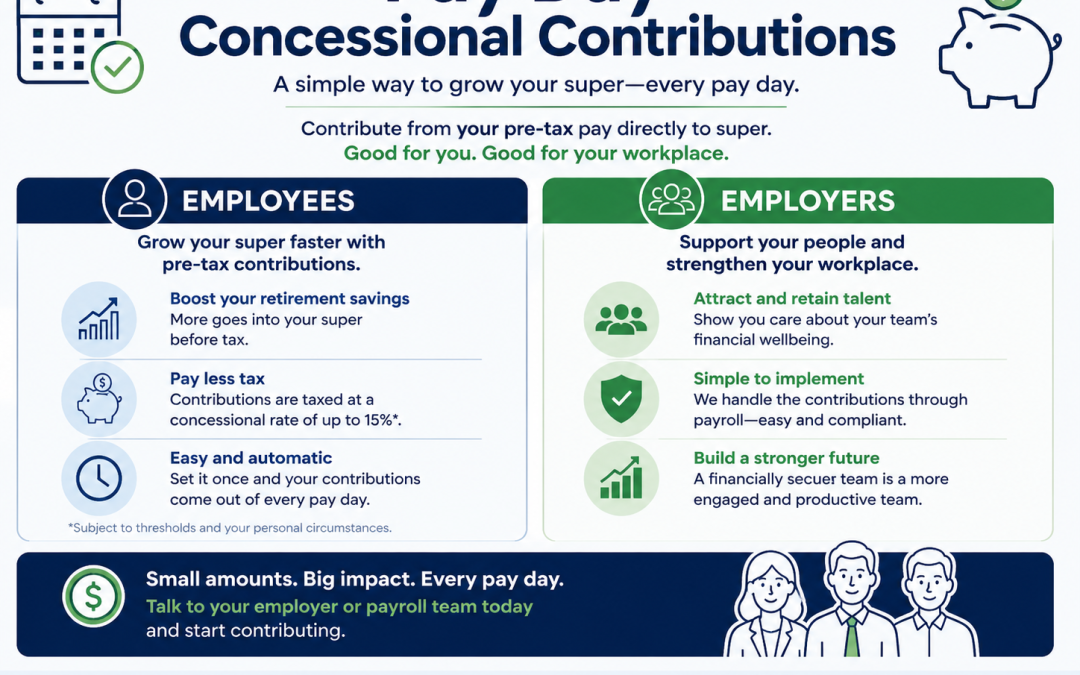
From 1 July 2026, Australia’s superannuation system will undergo one of its biggest changes in years with the introduction of Payday Super.
Under the new rules, employers will be required to pay superannuation guarantee (SG) contributions at the same time employees are paid their salary or wages, rather than quarterly. While the reform is designed to improve compliance and help employees receive super faster, it may create temporary issues for some Australians during the transition period.
In particular, some employees could unintentionally exceed their concessional contribution caps during the 2026 or 2027 financial year due to the timing of super payments. Although the Federal Government has announced it intends to introduce measures to prevent employees being unfairly penalised during the transition to Payday Super, the final legislative details are still being developed.
What Is Payday Super? Payday Super is a major reform to Australia’s superannuation system requiring employers to pay super contributions at the same time as wages and salaries are paid.
Currently, employers generally pay SG contributions quarterly. From 1 July 2026, contributions will instead need to be processed alongside each payroll cycle.
The objective is to:
- Improve employee retirement savings
- Reduce unpaid superannuation
- Increase transparency
- Improve cash flow into super funds
While the change benefits employees overall, it may temporarily affect how concessional contribution caps are calculated.
Why Some Employees Could Exceed Their Concessional Contribution Cap
Concessional contributions are counted when they are received by the super fund not when the income is earned. During the transition to Payday Super, some employees may receive more than 12 months’ worth of employer contributions within a single financial year.
For example:
- An employer may pay the June quarter super contribution in July
- The employer then begins paying super with every pay cycle under Payday Super
- This could result in 13 months of concessional contributions being counted in one year
This issue is particularly relevant for:
- High-income earners
- Employees using salary sacrifice arrangements
- Individuals already close to concessional contribution caps
Current Concessional Contribution Caps
For the 2026–27 financial year, the concessional contribution cap is expected to be:
- $32,500 per year
Concessional contributions include:
- Employer SG contributions
- Salary sacrifice contributions
- Personal deductible super contributions
Exceeding the cap does not automatically mean severe penalties apply, but it can create additional tax obligations and administrative complexity.
Will Exceeding the Cap Trigger Extra Tax? In most situations, exceeding the concessional contribution cap does not create a major negative tax outcome.
If excess concessional contributions occur:
- The excess amount is added back into the employee’s assessable income
- It is taxed at the employee’s marginal tax rate
- A 15% tax offset applies to reflect tax already paid within the super fund
Effectively, the excess amount is taxed similarly to ordinary salary or wages.
What Happens If You Exceed the Concessional Contribution Cap?
The process generally works as follows:
- Super Funds Report Contributions to the ATO
Super funds provide contribution information directly to the Australian Taxation Office (ATO).
- Carry Forward Concessional Contributions May Apply
If an employee’s total super balance is below $500,000, they may be able to use unused concessional contribution caps carried forward from the previous five financial years.
The ATO automatically applies eligible unused carry-forward amounts where available.
- The ATO Issues an Excess Concessional Contributions Determination
If excess contributions remain after applying carry-forward rules, the ATO will issue:
- An Excess Concessional Contributions Determination
- A Notice of Assessment or Amended Assessment
- Employees Choose How to Manage the Excess
Employees then decide whether to:
- Release the excess from super, or
- Leave the excess inside super and pay the additional tax personally
Option 1: Release the Excess Contributions
Employees can request the release of up to 85% of the excess concessional contribution amount through myGov.
The ATO then applies the released amount toward:
- Additional tax payable
- Existing tax debts
This is often the preferred option for individuals with large super balances.
Option 2: Leave the Excess Inside Super
Alternatively, employees can choose to leave the excess contributions inside super and pay the tax liability personally. However, the excess amount then counts toward the employee’s non-concessional contribution cap. This can create additional issues for high-balance super members.
If an employee’s total super balance exceeded $2 million at 30 June 2025, their non-concessional contribution cap for 2026–27 may be nil, meaning releasing the excess is generally recommended.
Worked Example: High-Income Employee
John’s Situation
John earns $250,000 annually and receives $30,000 in employer SG contributions. His employer previously paid super monthly in arrears but transitions to Payday Super during the financial year. As a result, John receives 13 monthly super payments during the 2026 financial year.
Outcome
- Total concessional contributions: $32,500
- Excess concessional contribution: $2,500
The ATO includes the excess $2,500 in John’s assessable income and applies the 15% offset. Because John’s total super balance exceeds $2 million, releasing up to 85% of the excess from super is generally the most effective option.
Worked Example: Employee with Salary Sacrifice
Sarah’s Situation
Sarah earns $100,000 annually and salary sacrifices additional amounts into super to maximise her concessional cap. Her employer currently pays super quarterly but transitions to Payday Super during the year.
Outcome
Without adjusting her salary sacrifice arrangement:
- Total concessional contributions would increase to $37,500
- Sarah would exceed the concessional cap
To avoid excess contributions, Sarah needs to reduce her salary sacrifice arrangement as her employer transitions to Payday Super.
Key Payday Super Tax Planning Strategies
Employees should proactively review their super arrangements before and during the transition to Payday Super.
Important considerations include:
- Monitoring total concessional contributions
- Reviewing salary sacrifice arrangements
- Checking eligibility for carry-forward concessional caps
- Understanding total super balance thresholds
- Seeking advice before exceeding contribution caps
High-income earners and individuals already close to their annual limits should pay particular attention during the 2026 and 2027 financial years.
Conclusion: Payday Super Creates New Planning Opportunities and Risks
The transition to Payday Super represents a significant shift in Australia’s superannuation system and will improve the speed and consistency of employer super payments over time.
However, during the implementation phase, some employees may unintentionally exceed their concessional contribution caps due to timing differences in super payments. While the tax consequences are generally manageable, employees with salary sacrifice arrangements or high super balances should review their contributions early and seek professional advice where necessary.
Proper planning before 30 June can help avoid unnecessary tax complications and ensure superannuation strategies remain effective under the new Payday Super rules.
How can we help?
If you have any questions or would like further information, please feel free to give our office on 08 9221 5522 or via email – info@camdenprofessionals.com.au or arrange a time for a meeting so we can discuss your requirements in more detail.
General Advice Warning
The material on this page and on this website has been prepared for general information purposes only and not as specific advice to any particular person. Any advice contained on this page and on this website is General Advice and does not take into account any person’s particular investment objectives, financial situation and particular needs.
Before making an investment decision based on this advice you should consider, with or without the assistance of a securities adviser, whether it is appropriate to your particular investment needs, objectives and financial circumstances. In addition, the examples provided on this page and on this website are for illustrative purposes only.
Although every effort has been made to verify the accuracy of the information contained on this page and on this website, Camden Professionals, its officers, representatives, employees, and agents disclaim all liability [except for any liability which by law cannot be excluded), for any error, inaccuracy in, or omission from the information contained in this website or any loss or damage suffered by any person directly or indirectly through relying on this information.
Recent Comments