
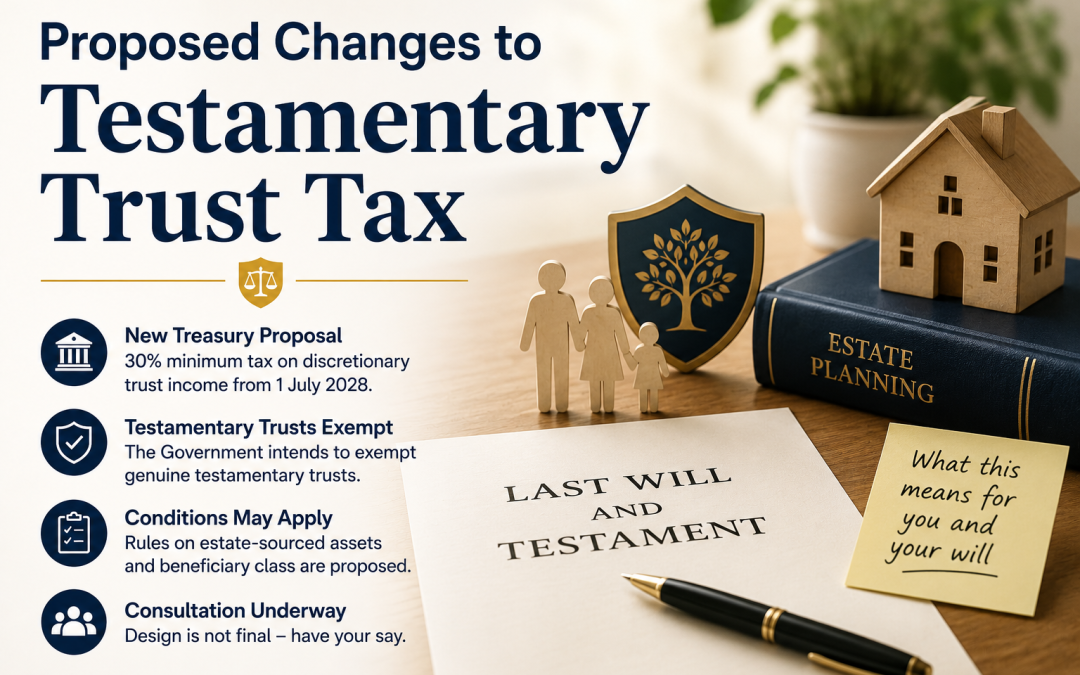
If you have a testamentary trust in your Will, or you’re thinking about including one, you may have heard about the Government’s proposal to introduce a 30% minimum tax on discretionary trust income.
The Government has announced that testamentary trusts are intended to be exempt from these proposed rules. However, the legislation has not yet been passed, and some important details are still being worked through by Treasury.
While there is no need to make rushed decisions, now is a good time to understand what has been proposed and what it could mean for your estate planning.
What Is a Testamentary Trust?
A testamentary trust is a trust created through your Will. It doesn’t exist while you’re alive, it only comes into effect after your death when your estate is administered.
Many Australians use testamentary trusts because they can:
- Protect family assets.
- Provide flexibility in how money is distributed.
- Help protect beneficiaries from financial risk.
- Assist with blended family arrangements.
- Offer tax benefits, particularly where young children are beneficiaries.
For families with investment properties, businesses or significant wealth, testamentary trusts are often an important part of an estate plan.
What Is the Government Proposing?
In July 2026, Treasury released a consultation paper outlining how a proposed 30% minimum tax on discretionary trust income could operate from 1 July 2028.
The proposal aims to reduce the tax advantages of distributing trust income to adults on lower tax rates. Importantly, Treasury has confirmed that income from genuine testamentary trusts is expected to be exempt from the new tax.
However, the detailed rules have not yet been finalised and may change before any legislation is passed.
Why Are Testamentary Trusts Being Exempt?
The Government recognises that testamentary trusts are primarily used for estate planning, not for tax minimisation.
These trusts help families:
- Look after children.
- Protect vulnerable beneficiaries.
- Manage inheritances over many years.
- Preserve family wealth.
Because of these legitimate purposes, Treasury has indicated that testamentary trusts should continue receiving favourable treatment.
Is the Exemption Automatic?
Not necessarily. Treasury has proposed that certain conditions may apply before a testamentary trust qualifies for the exemption. These may include:
Assets must come from the deceased person’s estate
The trust should mainly contain assets inherited from the deceased. If unrelated assets are later transferred into the trust, those assets may not qualify for the exemption.
The trust must be genuinely established through a Will
Treasury is also considering whether there should be limits on very broad beneficiary classes that extend well beyond normal family estate planning. These issues are still being consulted on and have not yet been finalised.
Do Existing Wills Need to Be Changed?
For most people, no. Having an older Will does not automatically mean you will lose the exemption. In fact, Treasury has not yet decided exactly when a testamentary trust will be regarded as being “established.”
Possible dates being considered include:
- The date the Will is signed.
- The date of death.
- The date probate is granted.
- The date assets are transferred into the trust.
Until these rules are settled, there is generally no reason to rewrite your Will solely because of these proposals.
What Should People with Existing Testamentary Trust Wills Do?
If you already have a testamentary trust in your Will, the best approach is simply to review your estate plan as you normally would. Consider whether:
- Your executor is still appropriate.
- Your trustee appointments remain suitable.
- Your beneficiaries are current.
- Your family circumstances have changed.
- Your assets have changed significantly.
If your Will already needs updating for personal reasons, your solicitor can also consider the proposed tax changes at the same time.
What Does This Mean for Executors?
If you are currently acting as an executor, your legal responsibilities do not change because of the consultation paper. However, if a testamentary trust will be created, you should seek professional advice before transferring estate assets into the trust, particularly if the new legislation is introduced before the estate is fully administered.
What Should Trustees Do?
Trustees of existing testamentary trusts do not need to make immediate changes.
Instead, they should continue to:
- Keep accurate financial records.
- Record where trust assets originated.
- Maintain proper trust accounts.
- Continue meeting annual tax and reporting obligations.
Good record keeping may become increasingly important if the proposed legislation is enacted.
Practical Tips
While nothing has changed yet, this is a good opportunity to:
- Review your Will every few years.
- Keep your estate planning documents up to date.
- Review trustee and executor appointments.
- Check your superannuation death benefit nominations.
- Speak with your solicitor or accountant if your circumstances have changed.
Good estate planning is about protecting your family, not simply reducing tax.
Conclusion
The Government’s proposal to exempt testamentary trusts from the new 30% minimum trust tax provides welcome certainty for many Australian families. However, the proposal is still under consultation, and several important design details remain unresolved.
For now, there is no need to make major changes simply because of the announcement. Instead, continue reviewing your estate plan regularly and obtain professional legal and tax advice whenever your personal or financial circumstances change.
A well-prepared estate plan remains one of the best ways to protect your family and ensure your wishes are carried out.
Frequently Asked Questions
Is the 30% trust tax already law?
No. The proposal is still being considered by Treasury and has not yet been passed by Parliament.
Will testamentary trusts pay the new 30% tax?
The Government has stated that genuine testamentary trusts are intended to be exempt, although the final legislation has not yet been released.
Should I change my Will now?
For most people, no. Unless your Will already needs updating for other reasons, it is generally sensible to wait until the final legislation is known.
What is a testamentary trust?
A testamentary trust is a trust created under your Will that begins after your death and allows assets to be managed for your beneficiaries.
Why are testamentary trusts popular?
They provide flexibility, asset protection, tax advantages for some beneficiaries and greater control over how inheritances are managed.
Will an older Will still qualify?
Possibly. Treasury has not yet decided whether the relevant date will be when the Will was signed, when the person dies or another event.
Do trustees need to do anything now?
No immediate changes are required, but trustees should continue maintaining accurate records and seek advice if the law changes.
Should I review my estate plan?
Yes. Regardless of tax law changes, reviewing your Will every few years or after major life events is considered good estate planning practice.
How can we help?
If you have any questions or would like further information, please feel free to give our office on 08 9221 5522 or via email – info@camdenprofessionals.com.au or arrange a time for a meeting so we can discuss your requirements in more detail.
General Advice Warning
The material on this page and on this website has been prepared for general information purposes only and not as specific advice to any particular person. Any advice contained on this page and on this website is General Advice and does not take into account any person’s particular investment objectives, financial situation and particular needs.
Before making an investment decision based on this advice you should consider, with or without the assistance of a securities adviser, whether it is appropriate to your particular investment needs, objectives and financial circumstances. In addition, the examples provided on this page and on this website are for illustrative purposes only.
Although every effort has been made to verify the accuracy of the information contained on this page and on this website, Camden Professionals, its officers, representatives, employees, and agents disclaim all liability [except for any liability which by law cannot be excluded), for any error, inaccuracy in, or omission from the information contained in this website or any loss or damage suffered by any person directly or indirectly through relying on this information.
Recent Comments