
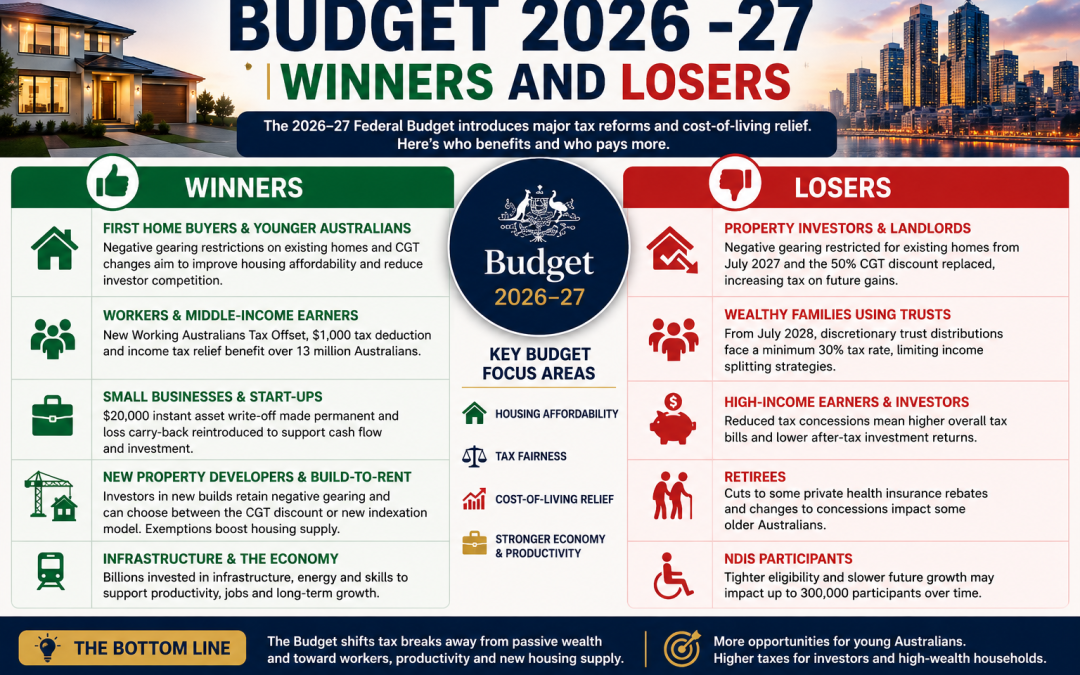
The 2026–2027 Federal Budget handed down by Treasurer Jim Chalmers on 12 May 2026 delivered one of the most aggressive tax reform agendas Australia has seen in decades.
The Albanese Government’s Budget focused heavily on housing affordability, wealth redistribution and structural tax reform, introducing major changes to negative gearing, capital gains tax (CGT) and discretionary trusts. The reforms have created clear winners and losers across households, investors, businesses and retirees.
Winners: First Home Buyers and Younger Australians
One of the biggest winners from the 2026 Budget is expected to be first-home buyers.
The Government announced sweeping restrictions on negative gearing for existing residential properties purchased after Budget night, while also replacing the 50% CGT discount with an inflation indexation model from 1 July 2027. The reforms are designed to reduce investor demand for established homes and improve affordability for owner-occupiers.
Treasury estimates suggest the changes could help around 75,000 additional Australians enter the housing market over the next decade. Younger buyers competing against leveraged investors in Sydney and Melbourne are expected to benefit the most.
Winners: Workers and Middle-Income Earners
Workers also emerged as major beneficiaries in the Budget.
The Government announced a new Working Australians Tax Offset (WATO), a $1,000 instant tax deduction and ongoing income tax relief measures designed to offset bracket creep and rising living costs. More than 13 million Australians are expected to benefit from the combined tax measures.
The Budget also included fuel excise relief and additional infrastructure spending aimed at easing household pressure from inflation and transport costs.
Winners: Small Businesses and Start-Ups
Small businesses received several targeted incentives in the 2026–2027 Budget.
The Government confirmed the permanent extension of the $20,000 instant asset write-off and reintroduced loss carry-back rules for eligible companies. Start-ups and technology businesses may also receive concessions following planned consultation around how the new CGT rules interact with innovation and early-stage investment.
For SMEs facing rising operating costs, the measures provide some immediate cash flow support despite broader economic uncertainty.
Winners: New Property Developers and Build-to-Rent Projects
While existing property investors were heavily targeted, developers of new housing stock benefited significantly.
The Government confirmed that investors purchasing newly built residential properties will still retain access to negative gearing and can choose between the traditional 50% CGT discount or the new indexation model.
Build-to-rent projects, affordable housing developments and some institutional investors were also exempted from the new restrictions to encourage housing supply. This is expected to boost large-scale apartment and housing developments over the coming years.
Losers: Property Investors and Landlords
Property investors were among the biggest losers in the Budget.
Negative gearing restrictions and CGT reforms dramatically reduce the tax advantages historically associated with residential property investing. Investors purchasing established homes after 12 May 2026 will lose the ability to offset rental losses against wage income from July 2027.
At the same time, the abolition of the 50% CGT discount increases tax payable on future capital gains for many investors.
Critics argue the changes could discourage investment in rental housing and place upward pressure on rents over time, particularly in already undersupplied markets.
Losers: Wealthy Families Using Trust Structures
High-income families using discretionary trusts also face major changes.
From 1 July 2028, discretionary trust distributions will face a minimum 30% tax rate under the Government’s proposed reforms. The changes are aimed at reducing income splitting strategies commonly used to distribute income to lower-taxed family members.
Treasury estimates the trust reforms alone could raise billions in additional revenue over the decade. Wealthier households with complex family trust arrangements are expected to face significantly higher effective tax rates.
Losers: Retirees and Some NDIS Participants
Retirees and some welfare recipients were also identified as potential losers in the Budget.
Media reporting following Budget night highlighted reductions to private health insurance rebates for some retirees and significant projected cuts to future NDIS growth. Reports suggest up to 300,000 participants could eventually lose eligibility under tighter assessment rules.
Social service organisations criticised the Budget for focusing too heavily on structural savings while offering limited new cost-of-living support for vulnerable Australians.
Summary: A Budget Focused on Tax Reform and Housing Affordability
The 2026–2027 Federal Budget represents a major turning point in Australian tax policy.
The Government has clearly shifted its focus toward reducing tax concessions linked to passive wealth accumulation while increasing support for workers, first-home buyers and productive investment. While younger Australians and wage earners appear to be the biggest winners, investors, landlords and wealthier families using trusts are likely to face significantly higher tax burdens over the next several years.
Sources:
Federal Budget Papers
The Guardian
Afr.com
How can we help?
If you have any questions or would like further information, please feel free to give our office on 08 9221 5522 or via email – info@camdenprofessionals.com.au or arrange a time for a meeting so we can discuss your requirements in more detail.
General Advice Warning
The material on this page and on this website has been prepared for general information purposes only and not as specific advice to any particular person. Any advice contained on this page and on this website is General Advice and does not take into account any person’s particular investment objectives, financial situation and particular needs.
Before making an investment decision based on this advice you should consider, with or without the assistance of a securities adviser, whether it is appropriate to your particular investment needs, objectives and financial circumstances. In addition, the examples provided on this page and on this website are for illustrative purposes only.
Although every effort has been made to verify the accuracy of the information contained on this page and on this website, Camden Professionals, its officers, representatives, employees, and agents disclaim all liability [except for any liability which by law cannot be excluded), for any error, inaccuracy in, or omission from the information contained in this website or any loss or damage suffered by any person directly or indirectly through relying on this information.
Recent Comments