
The Australian Government has announced significant proposed reforms to the Capital Gains Tax (CGT) system as part of the Treasury Laws Amendment (Tax Reform No. 1) Bill 2026.
If enacted, these changes will reshape the way capital gains are taxed from 1 July 2027, affecting individuals, trusts and partnerships that invest in property, shares and other capital assets.
For decades, the 50% CGT discount has been a cornerstone of long-term investment strategies in Australia. Under the proposed reforms, that discount would no longer apply to newly acquired assets after 30 June 2027. Instead, investors would move to an inflation-based cost base indexation system, while a new minimum tax rate on capital gains would also be introduced.
For property investors, business owners and long-term wealth creators, these proposed reforms could influence investment decisions, ownership structures and the timing of future asset disposals.
It is important to note that, at the time of writing, these measures are proposed legislation and have not yet become law. Investors should monitor the progress of the legislation and seek professional advice before making investment decisions.
What Are the Proposed Capital Gains Tax Changes?
The proposed reforms would apply to individuals, trusts and partnerships, while companies and superannuation funds would generally continue under the existing CGT framework.
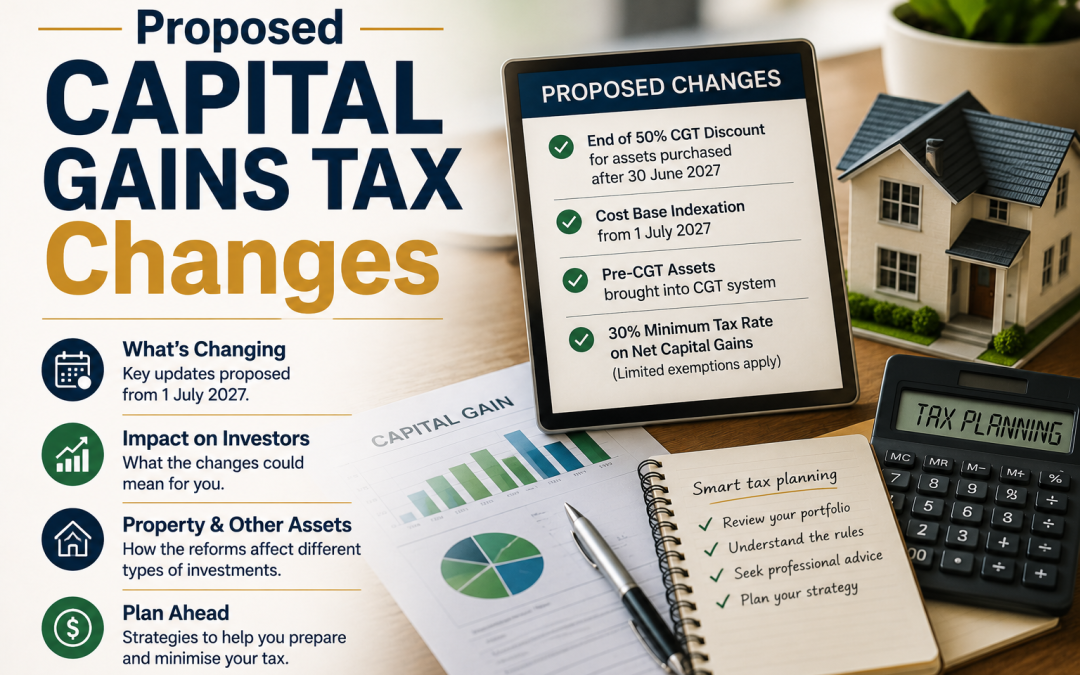
The key proposed changes include:
- Removal of the 50% CGT discount for assets acquired after 30 June 2027.
- Introduction of cost base indexation for assets purchased from 1 July 2027.
- Bringing pre-CGT assets (acquired before 20 September 1985) into the CGT system for future gains.
- Introduction of a minimum 30% tax rate on net capital gains, subject to limited exemptions.
- Transitional rules for assets already owned before 1 July 2027.
If implemented, these reforms would represent one of the most significant changes to Australia’s capital gains tax system since CGT was introduced in 1985.
The End of the 50% CGT Discount for New Investments
Under the current rules explained by the Australian Taxation Office (ATO), individuals and trusts that hold a CGT asset for at least 12 months can generally reduce their taxable capital gain by 50% before including it in their assessable income.
This concession has encouraged long-term investing in:
- Residential investment properties
- Commercial property
- Shares
- Managed funds
- Small businesses
- Other investment assets
Under the proposed reforms, this discount would no longer apply to assets acquired after 30 June 2027. Instead, investors would rely on cost base indexation to account for inflation over the ownership period.
Cost Base Indexation Replaces the CGT Discount
Rather than receiving a flat 50% discount, investors purchasing assets after 1 July 2027 would be able to increase the asset’s cost base by an indexed amount that reflects inflation. The objective is to tax only the “real” capital gain after inflation. While indexation may benefit investors during periods of high inflation and long ownership periods, investors experiencing rapid capital growth may find that the previous 50% discount produced a lower tax outcome.
The overall benefit will depend on:
- Inflation rates
- Holding period
- Asset performance
- Individual tax rates
Investors should model future scenarios before making major investment decisions.
Transitional Rules for Existing Investments
One of the most important aspects of the proposed legislation is how it treats assets already owned before the reforms commence.
Assets Bought and Sold Before 1 July 2027
These assets would continue under the existing CGT rules. Where held for more than 12 months, eligible taxpayers would generally continue to receive the 50% CGT discount.
Assets Purchased Before 1 July 2027 but Sold Afterwards
These investments would effectively be split into two periods.
Capital gains accumulated:
- Up to 30 June 2027 would generally be calculated under the current CGT rules.
- From 1 July 2027 onwards would be calculated using the new indexed cost base methodology.
This means investors holding long-term assets may need to obtain market valuations as at 30 June 2027.
Assets Purchased After 1 July 2027
All future capital gains would generally be calculated entirely under the new indexation rules.
Why Property Valuations Will Become More Important
One practical consequence of the transitional rules is the need to establish an accurate market value at 30 June 2027. For listed investments, market prices will generally be straightforward to determine.
However, for:
- Residential investment properties
- Commercial property
- Private companies
- Farms
- Unlisted investments
Professional valuations may become essential. Obtaining a qualified valuation will help establish the property’s market value when transitioning into the new CGT regime and may reduce future disputes with the Australian Taxation Office (ATO).
Proposed Changes for Pre-CGT Assets
Assets acquired before 20 September 1985 have historically been exempt from Capital Gains Tax. The proposed reforms would retain that exemption for gains accrued before 1 July 2027, but future gains would become taxable.
The proposal would work broadly as follows:
- Assets sold before 1 July 2027 would remain fully exempt.
- Assets retained beyond 30 June 2027 would receive a new market value cost base at 1 July 2027.
- Future gains above that market value would become subject to CGT using the new indexation rules.
For families holding long-term investment properties or farms acquired before 1985, obtaining an accurate market valuation will become particularly important.
New Proposed 30% Minimum Tax on Capital Gains
The proposed reforms would also introduce a minimum 30% tax rate on net capital gains for affected taxpayers. According to the Government, the objective is to reduce incentives for investors to defer selling assets until retirement or other low-income years purely to access lower marginal tax rates.
This proposal could affect:
- Retirement planning
- Succession planning
- Investment timing
- Trust distribution strategies
Investors may need to reconsider existing ownership structures and disposal strategies if the reforms proceed.
Special Concession for Newly Built Residential Properties
One notable feature of the proposed reforms is a concession designed to encourage investment in new housing supply. Investors who build or invest in qualifying new residential properties may be able to choose between:
- The existing 50% CGT discount; or
- The new indexed cost base method.
Importantly, eligible gains may continue to be taxed at the investor’s normal marginal tax rate rather than the proposed 30% minimum rate. If enacted, this concession could make new residential developments comparatively more attractive than established properties from a tax perspective.
What Does the Australian Taxation Office Say About CGT?
The Australian Taxation Office reminds investors that Capital Gains Tax is not a separate tax. Instead, any net capital gain is included in your assessable income and taxed at your applicable income tax rate.
The ATO also emphasises the importance of maintaining comprehensive records throughout the ownership period, including:
- Purchase contracts
- Settlement statements
- Stamp duty
- Legal fees
- Renovation costs
- Capital improvements
- Selling expenses
- Depreciation schedules
- Loan establishment costs where relevant
Good record keeping ensures an accurate calculation of your cost base and can significantly reduce the risk of disputes during an ATO review. The ATO also encourages taxpayers to seek professional advice where transactions involve trusts, inherited assets, mixed-use properties or complex ownership arrangements.
How Will These Changes Affect Property Investors?
If the legislation proceeds, Australian property investors may need to rethink many long-standing investment strategies. Some likely impacts include:
Greater emphasis on long-term tax planning
Investors may review whether acquisitions should occur before or after 1 July 2027.
Increased demand for professional property valuations
Valuations at 30 June 2027 may become critical evidence when calculating future capital gains.
Review of ownership structures
Trusts, partnerships and individual ownership may produce different tax outcomes under the new rules.
More detailed record keeping
Maintaining renovation records, acquisition costs and capital improvements will become even more important under an indexed cost base system.
Increased importance of professional advice
Tax modelling before buying or selling property is likely to become a standard part of investment planning.
What Should Investors Do Now?
Although the reforms are still proposed legislation, investors should begin preparing now by:
- Reviewing existing investment portfolios.
- Identifying assets that may be affected.
- Obtaining updated property valuations where appropriate.
- Ensuring all acquisition and improvement records are complete.
- Reviewing trust and ownership structures.
- Discussing future investment plans with their accountant or financial adviser.
- Monitoring the progress of the legislation.
Early planning provides greater flexibility should the reforms become law.
Conclusion
The proposed Capital Gains Tax reforms represent one of the most significant changes to Australia’s investment tax system in decades. The removal of the 50% CGT discount for future investments, the introduction of indexed cost bases and the proposed minimum tax on capital gains could materially affect investment returns for property investors and other asset owners.
While the legislation is not yet law, investors should not wait until 2027 to understand its potential implications. Reviewing investment structures, maintaining detailed records, obtaining appropriate valuations and seeking professional advice now can help position investors to respond effectively if the reforms are enacted.
As always, tax outcomes depend on individual circumstances, and decisions to acquire or dispose of assets should be made only after considering both the commercial and tax implications.
Frequently Asked Questions
Are the proposed CGT changes currently law?
No. The reforms are proposed legislation and will only apply if passed by Parliament. Investors should monitor legislative developments before making decisions.
Will the 50% CGT discount disappear?
Under the proposal, the 50% discount would no longer apply to assets acquired after 30 June 2027 by individuals, trusts and partnerships.
What is cost base indexation?
Instead of applying a flat discount, the purchase cost of an asset would be adjusted for inflation over the ownership period before calculating the capital gain.
Will existing investment properties be affected?
Yes. Assets owned before 1 July 2027 would generally be subject to transitional rules, with gains accrued before and after that date calculated under different methods.
Why is a property valuation important?
For assets held beyond 30 June 2027, a professional valuation may be needed to establish the property’s market value for transitional CGT calculations.
Do companies lose the CGT discount?
Companies generally do not receive the 50% CGT discount under the current rules, and the proposed reforms primarily affect individuals, trusts and partnerships.
What records does the ATO recommend keeping?
The ATO recommends retaining purchase contracts, legal costs, improvement expenses, depreciation schedules, selling costs and any documents affecting the property’s cost base.
Should investors review their ownership structures?
Yes. Given the proposed changes, reviewing ownership structures with a qualified tax adviser may help ensure future investments remain tax effective.
How can we help?
If you have any questions or would like further information, please feel free to give our office on 08 9221 5522 or via email – info@camdenprofessionals.com.au or arrange a time for a meeting so we can discuss your requirements in more detail.
General Advice Warning
The material on this page and on this website has been prepared for general information purposes only and not as specific advice to any particular person. Any advice contained on this page and on this website is General Advice and does not take into account any person’s particular investment objectives, financial situation and particular needs.
Before making an investment decision based on this advice you should consider, with or without the assistance of a securities adviser, whether it is appropriate to your particular investment needs, objectives and financial circumstances. In addition, the examples provided on this page and on this website are for illustrative purposes only.
Although every effort has been made to verify the accuracy of the information contained on this page and on this website, Camden Professionals, its officers, representatives, employees, and agents disclaim all liability [except for any liability which by law cannot be excluded), for any error, inaccuracy in, or omission from the information contained in this website or any loss or damage suffered by any person directly or indirectly through relying on this information.
Recent Comments