
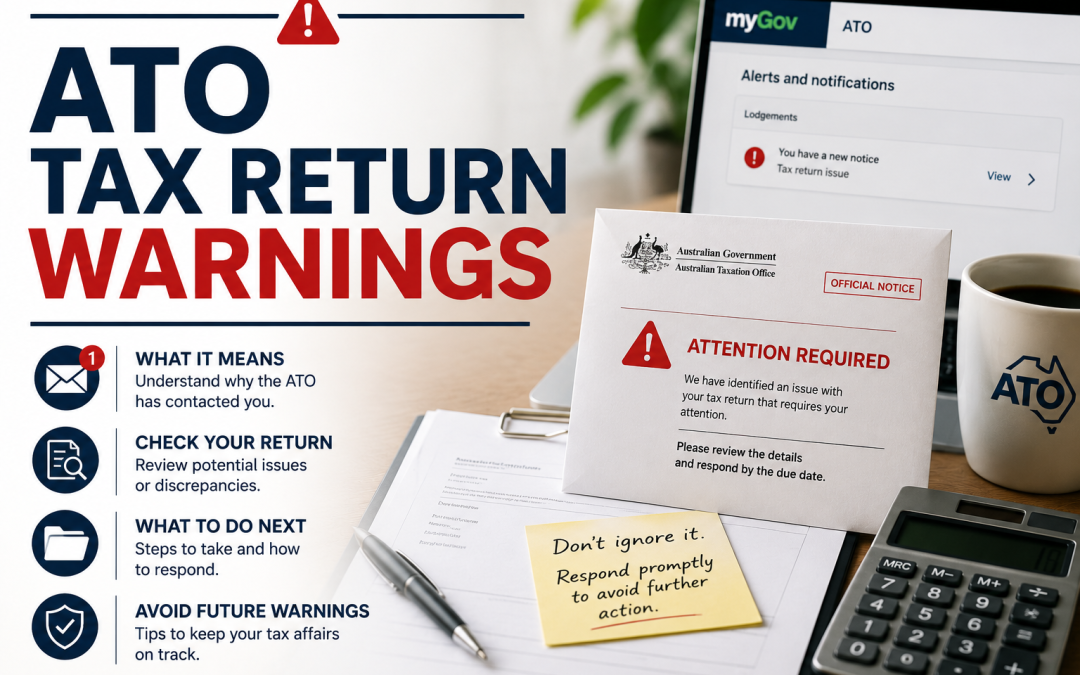
Receiving a warning from the Australian Taxation Office (ATO) can be worrying, but it doesn’t necessarily mean you’ve done anything wrong.
In many cases, an ATO tax return warning is simply a request to review information in your tax return because it doesn’t match data the ATO has received from employers, banks, government agencies or other organisations. A warning is not the same as an audit, and most issues can be resolved quickly by responding promptly and providing the right documentation.
What Is an ATO Tax Return Warning?
An ATO tax return warning is a formal notification advising that something in your tax return requires further review. The ATO uses sophisticated data-matching technology to compare information reported in your tax return with information it receives from sources including:
- Employers through Single Touch Payroll
- Banks and financial institutions
- Share registries
- Government agencies
- Managed funds
- Cryptocurrency exchanges
- Ride-sharing and delivery platforms
- Short-term accommodation platforms
If something doesn’t match, the ATO will often issue a warning before taking any further action. This gives taxpayers an opportunity to review their return, correct any mistakes or provide supporting information.
ATO Warning vs ATO Audit
Many people assume a warning means they are being audited, but these are two very different processes.
| ATO Warning | ATO Audit |
| Alerts you to a possible issue in your tax return. | A formal investigation into your tax affairs. |
| Usually occurs before or shortly after your assessment. | Usually occurs after the ATO identifies a significant issue. |
| Often resolved by providing information or correcting your return. | May involve extensive requests for financial records and documentation. |
| Low risk of penalties if dealt with promptly. | Greater risk of penalties if errors or omissions are identified. |
Receiving a warning does not mean an audit is inevitable. However, ignoring the warning can increase the likelihood of further ATO action.
How to Tell if an ATO Warning Is Genuine
Unfortunately, scammers regularly pretend to be the ATO. Before responding, make sure the communication is legitimate.
The ATO usually contacts taxpayers through:
- Letters sent to your registered postal address.
- Messages in your ATO Online account through myGov.
- Verified phone calls from the ATO.
Be cautious if you receive messages that:
- Demand immediate payment.
- Threaten arrest or legal action.
- Request payment using gift cards or cryptocurrency.
- Ask you to click links in text messages or emails.
- Request your Tax File Number or banking details unexpectedly.
If you’re unsure, don’t respond. Instead, contact the ATO directly using the official phone number listed on the ATO website.
Why Did You Receive an ATO Warning?
There are several common reasons why the ATO may contact you.
- Your Income Doesn’t Match ATO Records
The most common reason is that income reported in your tax return doesn’t match information the ATO has received.
This may include:
- Salary and wages
- Interest from bank accounts
- Dividends
- Managed fund distributions
- Government payments
Sometimes this simply happens because a taxpayer lodged their return before their income statement was marked “Tax Ready.”
- Your Deductions Are Higher Than Expected
The ATO compares deductions claimed by taxpayers working in similar occupations.
If your deductions are significantly higher than the industry average, your return may be selected for review. This doesn’t mean your claims are incorrect,it simply means you’ll need evidence to support them.
Receipts, logbooks and written records are often enough to explain legitimate claims.
- You Didn’t Declare All Your Income
The ATO receives information from many third-party platforms.
Income from activities such as:
- Uber
- DoorDash
- Airbnb
- Freelance work
- Online marketplaces
These must generally be declared in your tax return. If it isn’t, the ATO’s systems will often identify the discrepancy automatically.
- You Have Outstanding Tax Returns or Debts
Warnings may also be issued if:
- You haven’t lodged previous tax returns.
- You owe tax.
- Your refund may be used to offset another government debt.
These warnings are often intended to encourage taxpayers to act before stronger enforcement measures are taken.
- Your Return Was Selected Randomly
Occasionally, returns are selected as part of the ATO’s random compliance program. This doesn’t necessarily indicate a problem, it simply means your return has been chosen for review.
Will an ATO Warning Delay My Tax Refund?
Yes, it can. If your return is under review, the ATO will usually hold your refund until the issue has been resolved. The length of the review depends on the complexity of the issue. Simple corrections may only take a few weeks, while more detailed reviews involving multiple claims can take longer.
What Should You Do After Receiving an ATO Warning?
The most important thing is don’t ignore it. A practical approach includes:
Read the warning carefully
Understand exactly what the ATO is asking about.
Gather your records
Collect receipts, invoices, bank statements, logbooks and any other documents supporting your tax return.
Decide whether your return needs correcting
If you made a mistake, lodging an amendment may resolve the issue quickly. If your claim is correct, prepare the supporting evidence and respond accordingly.
Seek professional advice
If you’re unsure, a registered tax agent can communicate directly with the ATO on your behalf.
Respond before the deadline
Responding promptly usually results in a faster and simpler resolution.
What Documents Should You Keep?
The documents required depend on the issue being reviewed.
Common records include:
- Receipts and invoices
- Vehicle logbooks
- Work-from-home records
- Bank statements
- Income statements
- Dividend statements
- Contracts
- Diary notes
- Gig economy income summaries
The ATO generally recommends keeping tax records for at least five years after lodging your return.
What Happens If You Ignore an ATO Warning?
Ignoring an ATO warning rarely makes the issue disappear. Depending on the circumstances, the ATO may:
- Amend your tax return without your input.
- Issue penalties.
- Charge interest.
- Commence a formal audit.
- Review previous years’ tax returns.
Responding early generally results in a much better outcome than waiting for the ATO to take further action.
How Can You Reduce the Chance of Receiving Another Warning?
While no one can guarantee they won’t receive an ATO review, you can significantly reduce the risk by following some simple practices.
These include:
- Wait until your income statement is marked Tax Ready before lodging.
- Declare all income, including investment and gig economy earnings.
- Only claim deductions you can substantiate.
- Keep receipts and records for at least five years.
- Correct mistakes promptly if you discover them.
- Consider using a registered tax agent who understands current ATO compliance focus areas.
Conclusion
Receiving an ATO tax return warning doesn’t automatically mean you’ve made a serious mistake or that you’re about to face an audit. Most warnings arise because the ATO’s data doesn’t match the information reported in your tax return or because a deduction requires further explanation.
The key is to act promptly. Read the warning carefully, gather your supporting documents and seek professional advice if you’re unsure how to respond. Ignoring an ATO warning can lead to penalties, delayed refunds and further compliance action, while addressing it early often results in a straightforward resolution.
Frequently Asked Questions
Does an ATO warning mean I’m being audited?
No. A warning is simply a request to review or explain information in your tax return. It is different from a formal audit.
Why did I receive an ATO warning?
Common reasons include income mismatches, large deduction claims, undeclared investment or gig economy income, outstanding tax returns or random compliance reviews.
Will my tax refund be delayed?
Possibly. The ATO will usually hold your refund until the issue has been resolved.
What should I do first?
Read the warning carefully, gather your records and determine whether you need to amend your tax return or provide additional information.
Can I ignore an ATO warning?
No. Ignoring the warning can result in penalties, amended assessments or even a formal audit.
How long should I keep my tax records?
The ATO generally recommends keeping records for at least five years after lodging your tax return.
Should I contact a tax agent?
If you’re unsure why you received the warning or how to respond, engaging a registered tax agent can help resolve the issue quickly and ensure your rights are protected.
How can I avoid future ATO warnings?
Wait until your income information is complete before lodging, declare all income, keep good records and only claim deductions you can support with evidence.
How can we help?
If you have any questions or would like further information, please feel free to give our office on 08 9221 5522 or via email – info@camdenprofessionals.com.au or arrange a time for a meeting so we can discuss your requirements in more detail.
General Advice Warning
The material on this page and on this website has been prepared for general information purposes only and not as specific advice to any particular person. Any advice contained on this page and on this website is General Advice and does not take into account any person’s particular investment objectives, financial situation and particular needs.
Before making an investment decision based on this advice you should consider, with or without the assistance of a securities adviser, whether it is appropriate to your particular investment needs, objectives and financial circumstances. In addition, the examples provided on this page and on this website are for illustrative purposes only.
Although every effort has been made to verify the accuracy of the information contained on this page and on this website, Camden Professionals, its officers, representatives, employees, and agents disclaim all liability [except for any liability which by law cannot be excluded), for any error, inaccuracy in, or omission from the information contained in this website or any loss or damage suffered by any person directly or indirectly through relying on this information.
Recent Comments