
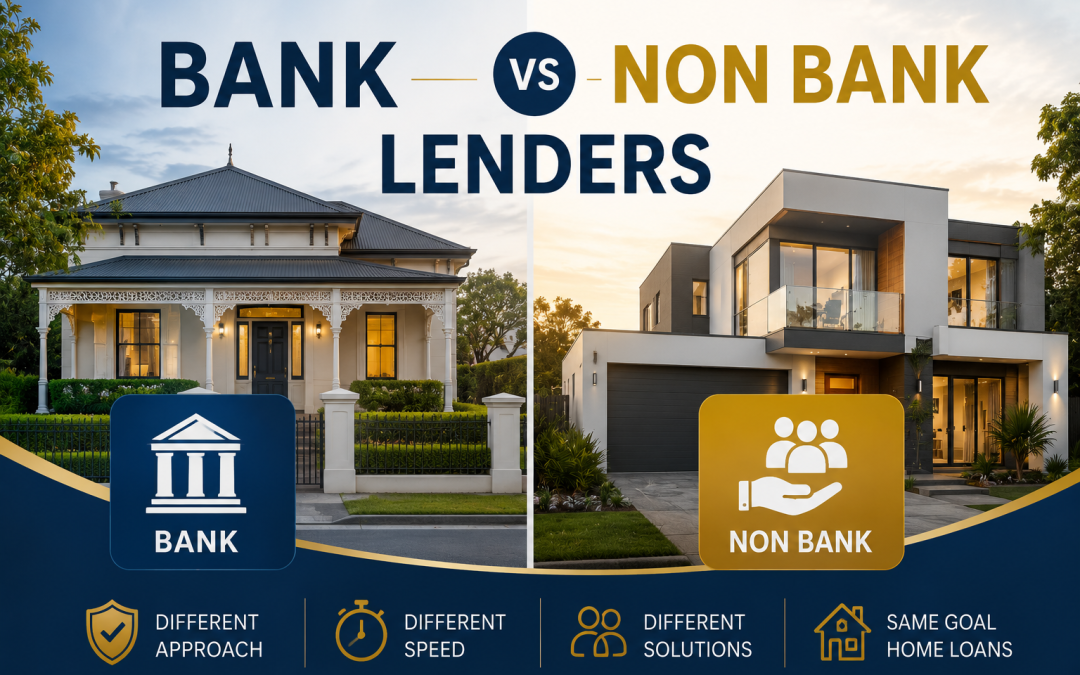
Australia’s property investment landscape is evolving, and so too are the financing strategies behind it. While the major banks still dominate the mortgage market, a growing number of investors are turning to non-bank lenders for greater flexibility, faster approvals, and tailored loan structures.
Backed by insights from institutions like the Reserve Bank of Australia and Australian Securities and Investments Commission, the rise of non-bank lending reflects changing borrower needs particularly among investors with complex financial situations.
What Is a Non-Bank Lender in Australia?
A non-bank lender is a financial institution that provides loans but does not hold customer deposits. Unlike traditional banks, these lenders are not authorised deposit-taking institutions (ADIs).
Major banks such as Commonwealth Bank, National Australia Bank, Westpac and ANZ are regulated as ADIs by the Australian Prudential Regulation Authority, meaning they can accept deposits and are subject to strict prudential oversight.
Non-bank lenders, on the other hand:
- Cannot accept deposits
- Are not regulated by APRA in the same way
- Must hold an Australian Credit Licence
- Operate under the National Consumer Credit Protection Act
They are regulated and monitored by ASIC, ensuring they meet responsible lending obligations despite their different funding structure.
How Non-Bank Lenders Fund Home Loans
Instead of using customer deposits, non-bank lenders rely on wholesale funding sources.
According to the Reserve Bank of Australia:
- Non-banks commonly use securitisation
- Funding is raised through mortgage-backed securities (MBS)
- Warehouse funding facilities are often used to support lending
While funding conditions tightened during the Global Financial Crisis, government support and improved market conditions have helped the sector recover and grow steadily since the mid-2010s.
Why Property Investors Are Choosing Non-Bank Lenders
Flexibility for Complex Borrowers
Non-bank lenders are particularly attractive to:
- Self-employed borrowers
- Investors with multiple properties
- Borrowers with higher debt-to-income ratios
Traditional banks often apply stricter assessment criteria, which can limit borrowing options for these groups.
Faster Loan Approvals and Streamlined Processes
Non-bank lenders typically operate with:
- Leaner approval systems
- Faster turnaround times
- More digital-first platforms
This speed can be critical in competitive property markets where timing can determine whether a deal is secured.
Investor-Friendly Loan Products
Many non-bank lenders offer products tailored to investors, including:
- Interest-only loans
- Flexible repayment structures
- Customised lending solutions
These options can better align with investment strategies focused on cash flow or portfolio growth.
Serviceability Flexibility Beyond APRA Constraints
Banks regulated by APRA must apply a minimum 3% serviceability buffer when assessing loan applications.
Non-bank lenders are not bound by this exact requirement, which can:
- Increase borrowing capacity
- Provide more flexibility in loan structuring
However, they must still comply with responsible lending laws enforced by ASIC.
Growing Market Share and Innovation
The non-bank sector has grown significantly since around 2015, supported by:
- Fintech innovation
- Increased competition in lending
- Rising demand for flexible finance options
Although still a smaller share of the overall lending market, non-banks are becoming a mainstream option for investors.
Bank vs Non-Bank: Which Is Better for Property Investors?
Why Some Investors Still Choose Banks
Traditional banks remain popular due to:
- Long-standing reputation and perceived stability
- Access to in-branch services
- Broad product ranges
For straightforward borrowers with stable income, banks often remain the default choice.
Why Investors Are Blending Lending Options
Many experienced investors now use a hybrid approach:
- Banks for standard residential lending
- Non-banks for complex or time-sensitive deals
This strategy allows investors to maximise borrowing capacity while maintaining flexibility across their portfolio.
Key Considerations Before Choosing a Lender
Before deciding between a bank and a non-bank lender, investors should assess:
- Their income structure and financial complexity
- Required speed of approval
- Loan features and flexibility
- Long-term investment strategy
Working with a mortgage broker or finance specialist can help navigate both lending environments effectively.
Conclusion: Matching the Lender to Your Investment Strategy
The rise of non-bank lending in Australia reflects a broader shift toward flexibility and borrower-specific solutions. While traditional banks continue to dominate, non-bank lenders are carving out a strong position, particularly among property investors with complex needs.
Ultimately, the right choice depends on your strategy. Whether prioritising speed, borrowing power, or simplicity, aligning your lender with your investment goals is key. Increasingly, investors are recognising that the best solution may not be one or the other but a combination of both.
How can we help?
If you have any questions or would like further information, please feel free to give our office on 08 9221 5522 or via email – info@camdenprofessionals.com.au or arrange a time for a meeting so we can discuss your requirements in more detail.
General Advice Warning
The material on this page and on this website has been prepared for general information purposes only and not as specific advice to any particular person. Any advice contained on this page and on this website is General Advice and does not take into account any person’s particular investment objectives, financial situation and particular needs.
Before making an investment decision based on this advice you should consider, with or without the assistance of a securities adviser, whether it is appropriate to your particular investment needs, objectives and financial circumstances. In addition, the examples provided on this page and on this website are for illustrative purposes only.
Although every effort has been made to verify the accuracy of the information contained on this page and on this website, Camden Professionals, its officers, representatives, employees, and agents disclaim all liability [except for any liability which by law cannot be excluded), for any error, inaccuracy in, or omission from the information contained in this website or any loss or damage suffered by any person directly or indirectly through relying on this information.
Recent Comments