
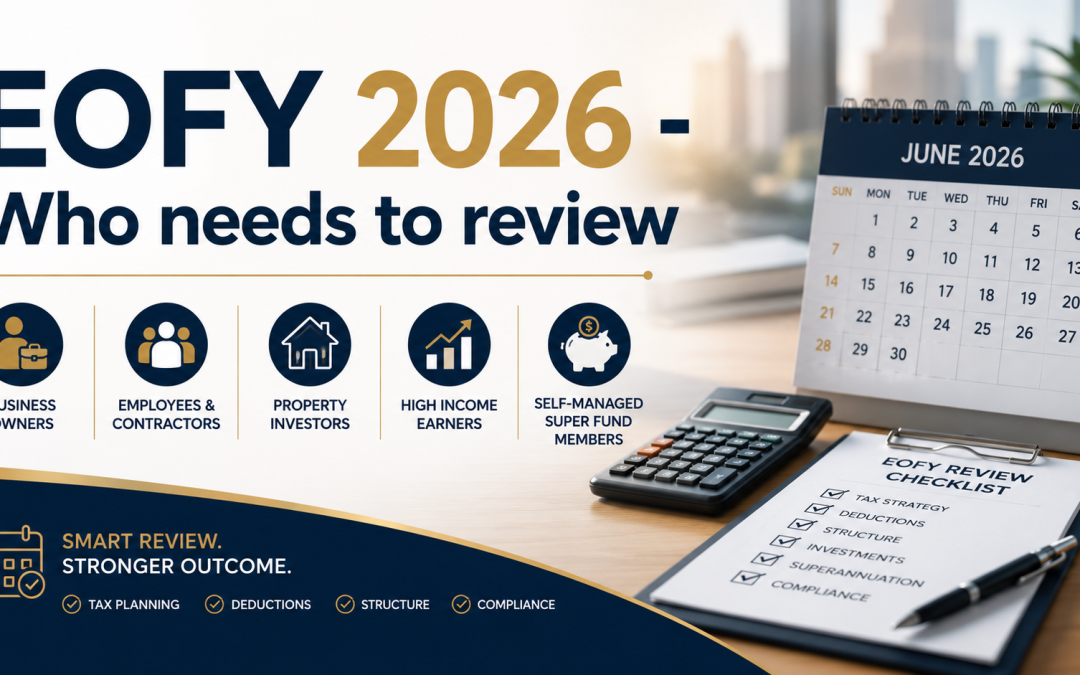
As the new financial year begins, many Australians focus solely on lodging their tax return. But EOFY is also one of the best times to step back and review your broader financial position.
With interest rates still elevated, cost-of-living pressures continuing, superannuation changes on the horizon, and ongoing discussion around trust structures and tax reform following the Federal Budget, a proactive financial review can make a significant difference to your long-term wealth.
The Australian Government, including the ATO, Moneysmart (ASIC) and Services Australia, consistently encourages Australians to review their finances, superannuation, insurance and budgeting regularly to stay on track with their goals.
- Homeowners with a Mortgage
If you have a home loan, EOFY is an ideal time to check whether your mortgage is still competitive. Even a small reduction in your interest rate can save thousands over the life of the loan.
Review:
- Your current interest rate.
- Whether you are making use of an offset account.
- Fixed vs variable loan structure.
- Whether refinancing could improve cash flow.
According to Moneysmart, borrowers should compare home loans regularly and understand all fees and features before refinancing.
- Investors Holding Too Much Cash
Higher interest rates have improved savings account returns, but inflation can still reduce the real value of cash over time.
EOFY is a good opportunity to assess:
- Whether your savings account is earning a competitive rate.
- How much emergency cash you genuinely need.
- Whether surplus funds could be allocated to longer-term investments such as shares, ETFs, bonds or property.
Moneysmart notes that diversification and matching investments to your risk tolerance and time horizon are key principles of investing.
Market volatility can feel uncomfortable, but it can also create opportunities. EOFY is the perfect time to review your portfolio and asset allocation.
Ask yourself:
- Is my portfolio too heavily weighted to one asset class?
- Do I need more diversification?
- Should I rebalance towards fixed income now that bond yields are higher?
- Are there capital losses that could be used to offset gains for tax purposes?
The ATO provides guidance on capital gains tax (CGT) and how capital losses can be used to offset capital gains.
- Business Owners and Trust Structures
Business owners using discretionary trusts or bucket companies should pay close attention to recent developments in trust taxation and Division 7A.
The recent Bendel High Court decision and proposed Federal Budget reforms have increased scrutiny on:
- Trust distributions.
- Bucket company arrangements.
- Unpaid present entitlements (UPEs).
- Section 100A risks.
- Future trust taxation changes from 1 July 2028.
EOFY is the right time to review:
- Trust resolutions.
- Distribution strategies.
- Division 7A loan arrangements.
- Asset ownership structures.
- Succession and estate planning objectives.
- Employees and Anyone with Superannuation
Superannuation remains one of the most tax-effective investment vehicles available to Australians. EOFY is the ideal time to review your super before the new year begins.
Check:
- Your super balance.
- Investment option (growth, balanced, conservative, etc.).
- Whether you have multiple super accounts.
- Insurance held inside super.
- Whether concessional or non-concessional contributions make sense for you.
The ATO encourages Australians to consolidate multiple super accounts to reduce unnecessary fees and insurance duplication. ATO Super for Individuals and Families
- Families Reviewing Insurance and Household Budgets
Inflation and rising construction costs mean many Australians may now be underinsured.
Review:
- Home and contents insurance sums insured.
- Income protection insurance.
- Life and TPD insurance.
- Private health insurance.
- Emergency savings buffer.
ASIC’s Moneysmart website recommends reviewing insurance regularly, especially after major life events or significant changes in asset values.
Why EOFY Is More Than Just Tax Time
EOFY should not just be about preparing receipts for your accountant. It is an opportunity to:
- Reduce unnecessary borrowing costs.
- Improve cash flow.
- Rebalance investments.
- Maximise super contributions.
- Review tax structures.
- Ensure insurance cover is adequate.
- Reset financial goals for the year ahead.
In a changing economic environment, proactive planning is often more valuable than reactive decision-making.
Frequently Asked Questions (FAQs)
How often should I review my financial position?
At least annually, ideally around EOFY. You should also review your finances after major life events such as buying property, changing jobs, starting a business, getting married, or nearing retirement.
Should I refinance my mortgage in 2026?
It depends on your current rate, loan features, fees and long-term plans. Comparing loans and speaking with your lender or mortgage broker can help determine whether refinancing would improve your situation.
What should I check in my superannuation account?
Review your balance, investment option, fees, insurance cover, contribution levels and whether you have multiple accounts that could be consolidated.
Can I use capital losses to reduce tax?
Yes. Under ATO rules, capital losses can generally be used to offset capital gains in the same financial year or carried forward to future years. ATO CGT Guide
ATO CGT Guide
Do trust structures need to be reviewed after the Federal Budget?
Is holding cash still a good strategy?
Cash is important for emergencies and short-term needs, but holding excessive cash long term may reduce purchasing power due to inflation. A balanced strategy tailored to your goals and risk tolerance is usually more effective.
Final Thought
EOFY is not just a deadline for tax returns. It is a strategic checkpoint for your entire financial life. Whether you are a homeowner, investor, business owner or employee, taking the time to review your mortgage, savings, investments, super, insurance and tax structures can help ensure your money is working harder for you in the year ahead.
Sources:
- Australian Taxation Office (ATO): https://www.ato.gov.au
- ASIC Moneysmart: https://moneysmart.gov.au
- Services Australia: https://www.servicesaustralia.gov.au
- ATO Capital Gains Tax Guide: ATO CGT Guide
- Moneysmart Home Loans Guide: Moneysmart Home Loans Guide
How can we help?
If you have any questions or would like further information, please feel free to give our office on 08 9221 5522 or via email – info@camdenprofessionals.com.au or arrange a time for a meeting so we can discuss your requirements in more detail.
General Advice Warning
The material on this page and on this website has been prepared for general information purposes only and not as specific advice to any particular person. Any advice contained on this page and on this website is General Advice and does not take into account any person’s particular investment objectives, financial situation and particular needs.
Before making an investment decision based on this advice you should consider, with or without the assistance of a securities adviser, whether it is appropriate to your particular investment needs, objectives and financial circumstances. In addition, the examples provided on this page and on this website are for illustrative purposes only.
Although every effort has been made to verify the accuracy of the information contained on this page and on this website, Camden Professionals, its officers, representatives, employees, and agents disclaim all liability [except for any liability which by law cannot be excluded), for any error, inaccuracy in, or omission from the information contained in this website or any loss or damage suffered by any person directly or indirectly through relying on this information.
Recent Comments