




Cash Flow Tips for Small Business Owners
For many Australian small business owners, cash flow is one of the biggest day-to-day financial challenges. A business can have strong sales and appear profitable on paper while still struggling to cover wages, suppliers, tax and superannuation.
Late-paying customers, rising costs, increasing wages, tax obligations and Payday Super from 1 July 2026 have made effective cash flow management even more important. The good news is that improving cash flow does not necessarily require major changes. Small improvements to invoicing, collections, pricing, forecasting and financial management can make a meaningful difference.
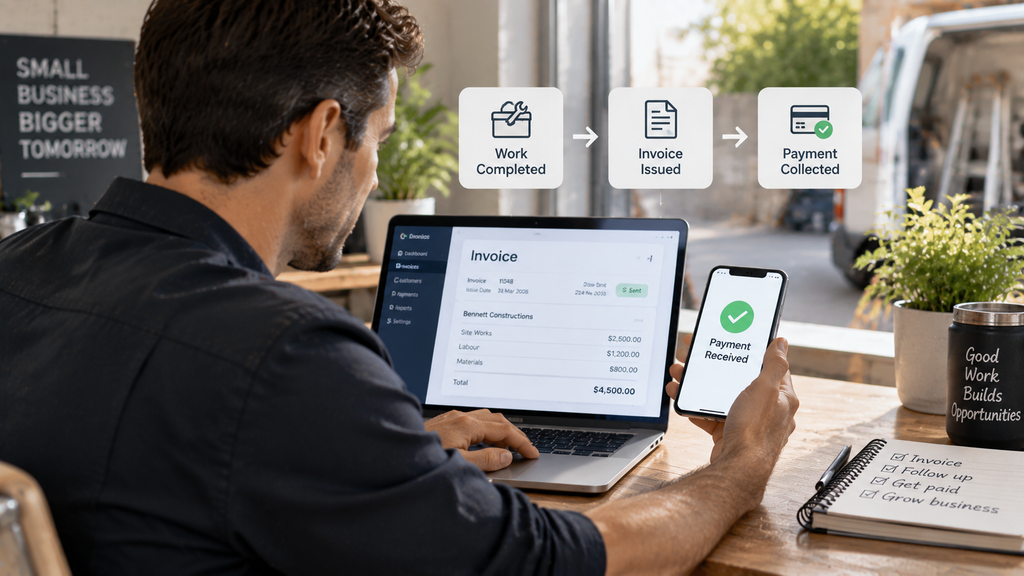
1. Invoice Customers as Soon as the Work Is Completed
One of the simplest ways to improve cash flow is to invoice promptly.
Every day between completing work and issuing an invoice can delay payment. Instead of waiting until the end of the week or month, consider making invoicing part of your normal job completion process.
Work completed → Invoice issued → Payment collected
Faster invoicing can help reduce the gap between money going out and money coming into the business.
2. Review Your Payment Terms
Payment terms have a significant impact on cash flow. If your business currently offers 30-day terms, consider whether shorter terms are appropriate for your industry and customers.
Depending on your business, options could include:
- 7-day or 14-day payment terms
- payment on completion
- deposits before work begins
- progress payments
- recurring direct debit arrangements.
Shorter terms do not guarantee faster payment, but they establish clearer expectations about when payment is due.
3. Make It Easy for Customers to Pay
The more difficult it is for customers to pay, the easier it is for invoices to remain outstanding.
Consider offering convenient options such as:
- EFT or bank transfer
- credit or debit card
- direct debit
- online payment links
- recurring payment arrangements.
Automated reminders, including a reminder shortly before an invoice falls due, can also encourage customers to pay on time.
Cash Flow Tip
Review your invoices from the customer’s perspective. Can they immediately see:
- how much they owe?
- when payment is due?
- how they can pay?
- where payment should be sent?
- what happens if payment is late?
If any of these are unclear, improving your invoicing process may help accelerate collections.
4. Have a System for Following Up Overdue Invoices
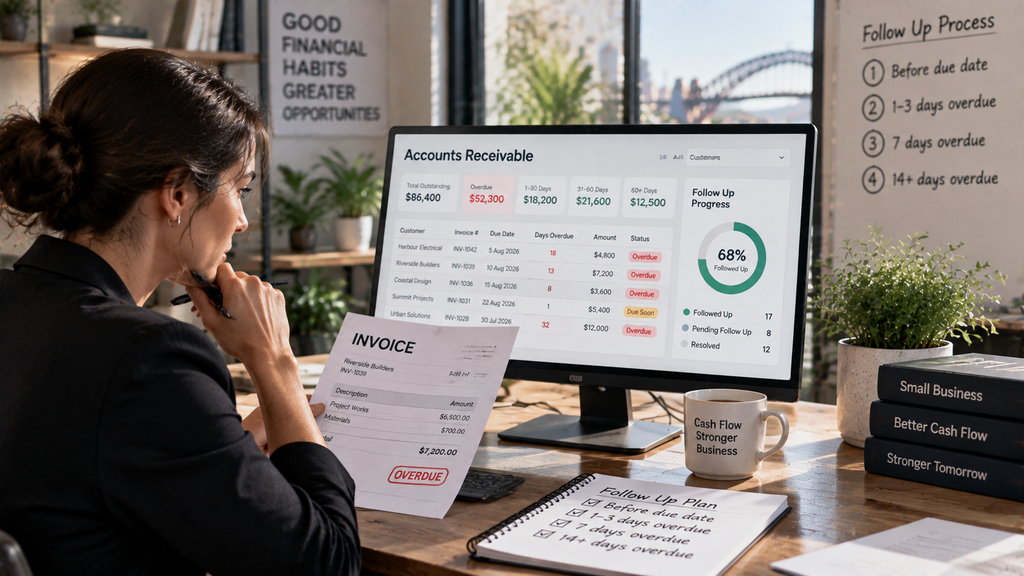
Late payments are a common cause of small business cash flow problems. Often, the issue is not that customers refuse to pay, but that there is no consistent process for following up outstanding invoices.
A simple process could be:
Before due date: Automated reminder
1–3 days overdue: Friendly reminder
7 days overdue: Email or phone follow-up
14+ days overdue: Formal notice or escalation
The exact process will depend on your business, but consistency is important.
Regularly review your accounts receivable ageing report so you know how much money is outstanding and how long customers have owed it.
5. Ask for Deposits and Progress Payments
For businesses undertaking large projects, waiting until completion before receiving payment can place unnecessary pressure on cash flow.
You may have already paid for wages, materials, subcontractors, equipment, travel and other overheads. Where appropriate, consider requesting a deposit or using staged payments.
For example:
30% deposit → 40% progress payment → 30% final payment
This can help align cash receipts with the costs of delivering the project.
6. Identify Customers Who Consistently Pay Late
Not every customer has the same payment behaviour. A customer with 30-day terms may regularly take 60 or 75 days to pay.
That distinction matters when preparing a cash flow forecast. If a customer consistently pays late, consider requesting a deposit, shortening payment terms, requiring progress payments, limiting credit or reflecting their actual payment behaviour in your forecast.
The key is to manage cash flow based on reality rather than assumptions.
7. Review Your Pricing When Costs Increase
Regularly reviewing pricing is an important but often overlooked cash flow strategy.
If wages, supplier costs, rent, insurance, software, superannuation or financing costs increase while your prices remain unchanged, your profit margin can gradually disappear.
A business can be busy and still become financially weaker. Regular pricing reviews help ensure prices continue to reflect the actual cost of delivering your products or services. Even a modest price increase across a large customer base can improve profitability and cash flow.

8. Don’t Let Excess Stock Tie Up Your Cash
For retail, wholesale, manufacturing and other inventory-based businesses, stock can represent a significant amount of money sitting on shelves.
The more cash tied up in inventory, the less available for wages, suppliers, tax, superannuation, loan repayments and business opportunities.
Regularly identify fast-moving, slow-moving, obsolete, excess and seasonal stock. Reducing unnecessary purchases or clearing slow-moving inventory may free up cash, while still maintaining enough stock to service customers.
9. Put Money Aside for GST, Tax and Superannuation
One of the biggest cash flow mistakes is treating money collected for tax obligations as available working capital.
GST collected from customers, for example, may temporarily sit in the business bank account but will ultimately be required to meet GST obligations.
Businesses should also plan for:
- PAYG withholding
- GST
- income tax
- superannuation
- payroll-related obligations.
A practical strategy is to maintain a separate tax or obligations account and regularly transfer an appropriate amount into it. This can reduce the risk of reaching BAS or tax payment time without enough cash available.
10. Understand Why Your Profit Doesn’t Always Match Your Bank Balance
A business can be profitable and still experience cash flow problems because accrual accounting and cash accounting measure different things.
Under accrual accounting, revenue may be recognised when an invoice is issued even though the customer has not paid.
For example, you issue a $50,000 invoice. Your profit and loss statement may recognise the revenue, but your bank balance does not increase until the customer actually pays. Meanwhile, the business may already have paid wages and suppliers.
Business owners should therefore monitor both:
Profitability – Is the business making money?
Cash flow – Is there enough cash available to meet upcoming obligations?
They are related, but they are not the same thing.
11. Prepare a 4, 8 or 13-Week Cash Flow Forecast
A cash flow forecast provides a forward-looking view of expected money coming into and going out of the business.
Expected cash coming in may include customer payments, deposits, loans and other income.
Expected cash going out may include:
- wages and superannuation
- suppliers
- rent
- GST and PAYG withholding
- tax
- loan repayments
- software and subscriptions
- other operating expenses.
A weekly forecast can identify potential shortages before they happen. If your forecast shows a $20,000 shortfall several weeks ahead, you have time to investigate options rather than discovering the problem on payday.

12. Keep Your Bookkeeping Up to Date
You cannot effectively manage cash flow using financial information that is weeks or months old.
Regular bookkeeping provides better visibility over:
- cash at bank
- unpaid and overdue invoices
- supplier bills
- payroll
- GST and PAYG withholding
- business expenses
- profitability.
Keeping records current also makes BAS preparation easier and helps identify financial problems earlier. Cloud accounting and automated bank feeds can make regular bookkeeping more efficient.
The objective is not simply accurate tax records. Your financial information should help you make better business decisions.
13. Prepare for Payday Super
Payday Super commenced from 1 July 2026, changing the timing of superannuation payments for employers.
Under the new system, employers are required to pay superannuation at the same time as salary and wages, with contributions reaching employees’ super funds within the applicable timeframe. Superannuation therefore needs to be incorporated into regular payroll cash flow planning, rather than being treated simply as a quarterly cash flow event.
What Small Business Owners Should Review
Check that:
- your payroll software is configured for Payday Super
- superannuation calculations are correct
- sufficient cash is available on payday
- your clearing house or payment system is working correctly
- employee super fund details are accurate
- payroll and bookkeeping processes are up to date.
For businesses with tight cash flow, more frequent superannuation payments make accurate forecasting particularly important.
Cash Flow and Wages: Why Planning Matters
For businesses with employees, wages are generally one of the largest recurring expenses. This makes payroll relatively easy to forecast when financial information is accurate.
A business should know:
- How much will payroll cost?
- When will it be paid?
- How much superannuation will be required?
- What tax and other payroll obligations are due?
- How much cash will remain afterwards?
A rolling cash flow forecast helps answer the more useful question:
“Will there be enough cash in four, eight or thirteen weeks?”
Rather than simply asking whether there is enough money in the bank today, business owners can identify potential problems early and take action.

Conclusion: Better Cash Flow Starts With Better Financial Visibility
Cash flow management is not about keeping a huge amount of money sitting in the bank. It is about knowing when money is coming in, when it needs to go out and identifying potential shortages before they become problems.
Getting invoices out quickly, following up overdue debts, reviewing pricing, managing inventory, separating tax obligations, keeping bookkeeping current and preparing regular cash flow forecasts can all improve financial certainty.
With Payday Super changing the timing of superannuation payments, businesses with employees also need to include superannuation in their regular payroll and cash flow planning.
If your business is profitable but regularly feels short of cash, consider speaking with your accountant or bookkeeper. Reviewing your cash flow forecast, debtor collection process, pricing, margins, expenses and upcoming tax and payroll obligations can help identify where improvements could have the greatest impact.
Frequently Asked Questions About Small Business Cash Flow
What is cash flow management for a small business?
Cash flow management involves monitoring the money coming into and leaving your business and ensuring sufficient cash is available to meet upcoming obligations such as wages, suppliers, tax, loans and superannuation.
How can I improve cash flow quickly?
Start by invoicing customers promptly, following up overdue accounts, reviewing payment terms, requesting deposits or progress payments and identifying unnecessary or poorly timed expenses.
Why is my business profitable but short of cash?
Profit and cash flow are different. A business may record revenue when an invoice is issued but not receive the cash until weeks later. At the same time, wages, suppliers and other expenses may need to be paid immediately.
How often should a small business prepare a cash flow forecast?
A weekly rolling cash flow forecast can be particularly useful for businesses with employees or tight cash flow. Many businesses use a 4-, 8- or 13-week forecast to identify upcoming cash pressure.
How does Payday Super affect small business cash flow?
From 1 July 2026, employers need to incorporate superannuation payments into their regular payroll cash flow planning. Superannuation is no longer simply a quarterly payment that can be treated separately from the normal payroll cycle.
Should I keep money aside for GST and tax?
Yes. Setting aside money progressively for GST, PAYG withholding, income tax and other obligations can help prevent a large tax bill from creating an unexpected cash flow problem.
When should a business owner seek help with cash flow?
If your business is profitable but regularly struggles to pay wages, suppliers or tax obligations, or if you are relying on overdrafts or credit to cover regular expenses, it is worth speaking with your accountant or bookkeeper before the situation becomes more serious.
General Information Disclaimer
The material on this page and on this website has been prepared for general information purposes only and not as specific advice to any person. Any advice contained on this page and on this website is General Advice and does not consider any person’s particular investment objectives, financial situation and particular needs.
Before making an investment decision based on this advice you should consider, with or without the assistance of a securities adviser, whether it is appropriate to your particular investment needs, objectives and financial circumstances. In addition, the examples provided on this page and on this website are for illustrative purposes only.
Although every effort has been made to verify the accuracy of the information contained on this page and on this website, Camden Professionals and/or Investax Group, its officers, representatives, employees, and agents disclaim all liability (except for any liability which by law cannot be excluded), for any error, inaccuracy in, or omission from the information contained in this website or any loss or damage suffered by any person directly or indirectly through relying on this information.
Small Business Planning for End of 2025 – Xmas Guide
The Christmas season is one of the busiest and most important times of the year for business owners. For some, it means record sales and long trading hours; for others, it means closing the doors for a well-deserved break. Either way, the lead-up to Christmas brings unique financial and operational challenges.
If you’re not prepared, it’s easy to feel the pressure of juggling cash flow, payroll, stock, compliance, and staff expectations all at once. But with the right planning, you can head into the holiday season with confidence, knowing your business is in good shape and the new year won’t start with financial stress.
- Cash Flow
The festive season can stretch cash flow to its limits. Between BAS and PAYG in November, staff wages and leave in December, and potentially reduced income if your business shuts down, money can tighten quickly.
The best strategy is to build a forward-looking cash flow forecast. Map out your income and expenses from November through February. Include extra costs like staff bonuses, holiday parties, and client gifts. If revenue dips, consider delaying major purchases and trimming non-essential expenses.
Chase overdue invoices early, and if needed, negotiate flexible payment terms with suppliers. A few proactive conversations now can make a big difference.
- Plan Payroll and Staff Leave Early
Payroll mistakes or unclear leave policies can derail even the best-laid plans. December often involves complex rosters, bonus payments, and penalty rates—so get organised early.
Confirm leave requests and communicate roster expectations. If payroll coincides with a public holiday, notify your team about any early payments. For businesses staying open, clarify who’s working and who’s covering shifts. Process bonuses well ahead of time to avoid clashes with year-end obligations.
Also, check that pay rates, leave loading, and entitlements align with awards or agreements to avoid compliance issues.
- Stocktake and Supplier Management
For some industries, December is the busiest time; for others, it’s the quietest. Align your stock and supplier plans accordingly.
Conduct a stocktake to identify what’s moving and what’s not. If December is your peak period, order early and factor in supplier closures. If business slows, avoid overstocking to preserve cash. Running a clearance or holiday promotion can help move old stock and boost cash reserves.
Keep suppliers in the loop about your trading hours and ask for theirs to avoid missed deliveries or service disruptions.
- Compliance
Tax and super obligations don’t pause for the holidays. Missing a January or February deadline can disrupt your momentum going into the new year.
Check that all BAS, PAYG, and superannuation lodgements are up to date before you close. Ensure your Single Touch Payroll is current and clarify any early January deadlines with your accountant.
Now is also a good time to consider some proactive tax planning—such as prepaying expenses, making additional super contributions, or reviewing your business structure—before 2026 begins.
- Christmas Parties and Staff Gifts
Celebrating your team’s hard work is a great tradition, but without a plan, the costs can add up quickly.
Set a realistic budget for parties, gifts, and client thank-yous—and stick to it. Small, thoughtful gestures can be just as meaningful as expensive gifts. Also, ensure these expenses are correctly recorded in your books, as not all will be tax-deductible.
- Protect Your Business While You’re Away
A closed business or empty premises can be vulnerable during the holidays. In addition to physical security, be mindful that cybercrime often increases over the break.
Check your insurance coverage—including business interruption, cyber insurance, and public liability. Back up critical data, update passwords, and enable multi-factor authentication. If shutting down for the holidays, turn off non-essential utilities and double-check security measures.
Conclusion
The holiday season brings both opportunities and challenges—but with thoughtful planning, you can make the most of the festive period while setting your business up for a smooth start to 2026. From managing cash flow and compliance to caring for your team and securing your operations, the steps you take now will pay off in peace of mind and stronger performance in the new year.
Start early, stay organised, and remember: a well-prepared business is one that can truly enjoy the holidays.
—————BOOK YOUR EXCLUSIVE 15 MINUTE ZOOM CONSULTATION————-
We offer a 15-minute no obligation consultation to existing property investors, first home buyers and small business owners who are looking at property investments, business and asset protection. To Book an Appointment simply click here and pick a time and date.
BOOK YOUR ZOOM APPOINTMENT HERE
How can we help?
If you have any questions or would like further information, please feel free to give our office on 08 9221 5522 or via email – info@camdenprofessionals.com.au or arrange a time for a meeting so we can discuss your requirements in more detail.
General Advice Warning
The material on this page and on this website has been prepared for general information purposes only and not as specific advice to any particular person. Any advice contained on this page and on this website is General Advice and does not take into account any person’s particular investment objectives, financial situation and particular needs.
Before making an investment decision based on this advice you should consider, with or without the assistance of a securities adviser, whether it is appropriate to your particular investment needs, objectives and financial circumstances. In addition, the examples provided on this page and on this website are for illustrative purposes only.
Although every effort has been made to verify the accuracy of the information contained on this page and on this website, Camden Professionals, its officers, representatives, employees, and agents disclaim all liability [except for any liability which by law cannot be excluded), for any error, inaccuracy in, or omission from the information contained in this website or any loss or damage suffered by any person directly or indirectly through relying on this information.
How to Avoid Common Bookkeeping Mistakes
If you’ve ever felt overwhelmed by your financial records, you’re not alone. Many small business owners encounter common bookkeeping mistakes that can disrupt operations and hinder growth. Here are some prevalent mistakes and effective strategies to avoid them.
- Chasing Down Late Payments: Staying on Top of Debtors
Unpaid invoices can severely impact your cash flow, making it difficult to cover expenses. Late-paying clients often leave you scrambling, which can distract you from growing your business.
Solution: Set clear payment terms and issue invoices promptly. Use automated reminders in your accounting software to follow up on overdue payments. For example, if you offer services and your client’s payment is overdue by two weeks, automate a friendly reminder to be sent every week until payment is made. Additionally, consider offering early payment incentives or setting up payment plans for clients who consistently pay late.
- Blurring the Lines: Mixing Business and Personal Finances
Mixing personal and business expenses can create a chaotic financial picture. This often happens when business owners use personal accounts for business transactions, complicating tax time and compliance.
Solution: Establish a separate bank account for your business. For instance, if you own a café, use this account solely for business-related transactions. This separation simplifies expense tracking and ensures your financial records remain clear, making it easier for your bookkeeper to manage your accounts.
- BAS and GST Stress: Staying on Top of Compliance
The burden of quarterly BAS lodgments and managing GST obligations can be overwhelming. Missing deadlines or making filing errors can lead to costly penalties.
Solution: Set calendar reminders for BAS due dates and ensure your bookkeeping software tracks GST on all relevant transactions. For example, if your café sells meals, keep meticulous records of GST collected and expenses related to GST. Regularly reviewing your GST codes and transactions will help you avoid mistakes.
- Falling Behind on Bank Reconciliations: Don’t Let It Pile Up
Procrastinating on bank reconciliations can lead to discrepancies and missed expenses. This task, if left unattended, can pile up and create significant stress.
Solution: Schedule a weekly reconciliation session. For instance, every Friday afternoon, dedicate 30 minutes to reconciling your bank statements. This routine helps you identify discrepancies early and maintain accurate cash flow statements.
- Manual Data Entry: Automate Where Possible
Relying on manual data entry can be tedious and error-prone, detracting from your productivity.
Solution: Use cloud-based bookkeeping software like Xero or MYOB to automate tasks. For example, if you regularly receive invoices from suppliers, tools like Hubdoc can automatically capture and sort these receipts, saving you time and reducing errors.
- Cash Flow Issues: Focus on Cash Flow, Not Just Profit
A profitable business can still struggle with cash flow if you overlook inflows and outflows.
Solution: Regularly review your cash flow statements. Create forecasts using your software to understand cash flow trends. For instance, if you notice a dip in cash flow during a particular season, you can plan ahead to ensure you have enough funds to cover expenses.
- Missed Deductions: Understand What’s Claimable
Many business owners are unaware of the deductions they can claim, leading to higher tax bills.
Solution: Keep detailed records of all business-related expenses. Work with a bookkeeper or accountant to identify deductible expenses specific to your industry. For example, if you operate a home office, you might be eligible to claim a portion of your utility bills as a business expense.
- Knowing When to Seek Professional Help
Handling your bookkeeping might work at the start, but as your business grows, the complexity increases.
Solution: Consider enlisting professional bookkeeping services. For instance, a skilled bookkeeper can help you not only manage your books but also provide insights into your financial health. This support allows you to focus on your core business activities while ensuring compliance and strategic planning.
Conclusion
Avoiding these common bookkeeping mistakes can lead to smoother operations and a more profitable business. By implementing these strategies, you can enhance your financial management and keep your focus on growing your business with confidence. Remember, seeking professional help is often the best investment you can make in your business’s financial future.
—————BOOK YOUR EXCLUSIVE 15 MINUTE ZOOM CONSULTATION————-
We offer a 15-minute no obligation consultation to existing property investors, first home buyers and small business owners who are looking at property investments, business and asset protection. To Book an Appointment simply click here and pick a time and date.
BOOK YOUR ZOOM APPOINTMENT HERE
How can we help?
If you have any questions or would like further information, please feel free to give our office on 08 9221 5522 or via email – info@camdenprofessionals.com.au or arrange a time for a meeting so we can discuss your requirements in more detail.
How can we help?
If you have any questions or would like further information, please feel free to give our office on 08 9221 5522 or via email – info@camdenprofessionals.com.au or arrange a time for a meeting so we can discuss your requirements in more detail.
General Advice Warning
The material on this page and on this website has been prepared for general information purposes only and not as specific advice to any particular person. Any advice contained on this page and on this website is General Advice and does not take into account any person’s particular investment objectives, financial situation and particular needs.
Before making an investment decision based on this advice you should consider, with or without the assistance of a securities adviser, whether it is appropriate to your particular investment needs, objectives and financial circumstances. In addition, the examples provided on this page and on this website are for illustrative purposes only.
Although every effort has been made to verify the accuracy of the information contained on this page and on this website, Camden Professionals, its officers, representatives, employees, and agents disclaim all liability [except for any liability which by law cannot be excluded), for any error, inaccuracy in, or omission from the information contained in this website or any loss or damage suffered by any person directly or indirectly through relying on this information.
Managing Cash Flow in a Higher Interest Rate Environment
As interest rates rise, property investors must adapt to new challenges in managing cash flow. This era of shifting financial landscapes requires strategic approaches and insights into market changes. From practical cash flow techniques to understanding the forecasted market trends, we’ve got you covered.
Understanding Cash Flow
Before diving into strategies, let’s revisit the basics – what is cash flow in the context of investment properties? Cash flow is the net relationship between the income generated and the expenses incurred. It’s the financial heartbeat of your investment, determining whether your property produces a surplus (positive cash flow) or operates at a deficit (negative cash flow).
Typical Income Sources
- Rent: The primary source of income for most investment properties is rent. Tenants pay rent to use the property, providing a steady stream of income for the property owner. The rental amount, typically agreed upon in the lease agreement, is a fundamental component of positive cash flow.
Typical Expenses
- Interest: Interest payments on loans associated with the investment property are significant expenses. This includes the mortgage interest used to purchase the property. Monitoring interest rates and choosing favourable financing terms can impact the property’s overall cash flow.
- Property Management: Hiring a property management company is a common practice for real estate investors. Property management fees cover services such as tenant screening, rent collection, and property maintenance. While an expense, professional management ensures the property is well-maintained and tenants are satisfied.
- Council Charges: Local councils often impose charges for services provided to the property, such as waste removal, water, and other municipal services. These charges contribute to the overall operational expenses of the property.
- Land Tax: Land tax is a state-imposed tax on the value of the land you own. It’s important to be aware of the land tax rates in your area, as they can vary. This expense is crucial in determining the property’s overall cash flow.
- Insurance: Insurance is essential for protecting your investment property. It typically covers property damage, liability, and loss of rental income. While insurance is an added cost, it provides financial security and mitigates potential risks.
- Repairs and Maintenance: Properties require ongoing maintenance and occasional repairs. Setting aside funds for routine maintenance and unforeseen repairs is essential for preserving the property’s value and ensuring tenant satisfaction.
Managing Cash Flow in a Higher Interest Rate Environment
PAYG Withholding Variation Form: One effective technique in managing cash flow is utilising the PAYG (Pay As You Go) withholding variation form. This form allows you to adjust the amount of tax withheld from your regular salary or wage income, providing more immediate access to funds. By tailoring your tax withholding, you can improve your monthly cash flow.
Using Equity for Buffers: In a higher interest rate environment, financial buffers become crucial. Consider tapping into the equity built up in your property portfolio. This can act as a financial cushion, allowing you to weather fluctuations in interest rates without compromising your overall financial stability.
Offset Accounts to Reduce Interest: Leverage the power of offset accounts to minimize interest payments. These accounts are linked to your mortgage, and the balance is offset against your loan, reducing the interest payable. This not only aids in interest reduction but also enhances your overall cash flow.
Investing Sooner Rather than Later: While rates are forecasted to come down at the end of 2024, the relief might also bring increased competition to the market. Investing sooner rather than later could provide a strategic advantage. By securing properties before the market heats up, you position yourself for potential capital growth and improved overall returns.
Interest only loans: You may be consider refinancing to an interest-only investment loan to reduce the monthly repayments. Check the pros and cons before going ahead. Make sure you can afford higher repayments at the end of the interest-only period.
On an interest-only home loan (mortgage), your repayments only cover interest on the amount borrowed (the principal). For a set period (for example, five years), you pay nothing off the amount borrowed, so it doesn’t reduce.
At the end of the interest-only period, the loan will change to a ‘principal and interest’ loan. You’ll start repaying the amount borrowed, as well as interest on that amount. That means higher repayments. It can be a shock when the interest-only period ends and your repayments go up. Here are some tips to help you manage the switch to principal and interest.
- Gradually increase your loan repayments
- Get a better deal on your loan. If your lender won’t give you a better deal, consider switching home loans.
- If you’re worried you can’t afford the new repayments, talk to your lender to discuss your options.
Conclusion
As interest rates ebb and flow, strategic cash flow management becomes a pivotal skill for property investors. From utilising tax variations to leveraging equity and offset accounts, these techniques provide a comprehensive toolkit to manage cash flow and seize opportunities in the ever-evolving property market. By adopting these strategies, investors can navigate higher interest rates while maintaining financial stability and positioning themselves for future growth.
—————BOOK YOUR EXCLUSIVE 15 MINUTE ZOOM CONSULTATION————-
We offer a 10-minute no obligation consultation to existing property investors, first home buyers and small business owners who are looking at property investments, business and asset protection. To Book an Appointment simply click here and pick a time and date.
BOOK YOUR ZOOM APPOINTMENT HERE
How can we help?
If you have any questions or would like further information, please feel free to give our office on 08 9221 5522 or via email – info@camdenprofessionals.com.au or arrange a time for a meeting so we can discuss your requirements in more detail.
General Advice Warning
The material on this page and on this website has been prepared for general information purposes only and not as specific advice to any particular person. Any advice contained on this page and on this website is General Advice and does not take into account any person’s particular investment objectives, financial situation and particular needs.
Before making an investment decision based on this advice you should consider, with or without the assistance of a securities adviser, whether it is appropriate to your particular investment needs, objectives and financial circumstances. In addition, the examples provided on this page and on this website are for illustrative purposes only.
Although every effort has been made to verify the accuracy of the information contained on this page and on this website, Camden Professionals, its officers, representatives, employees, and agents disclaim all liability [except for any liability which by law cannot be excluded), for any error, inaccuracy in, or omission from the information contained in this website or any loss or damage suffered by any person directly or indirectly through relying on this information.
Cash Flow Tips for Small Businesses
When it comes to running a small business, cash flow management is king. Effective cash flow management is the difference between running a successful business and, unfortunately, going out of business.
We’ve all heard the saying that ‘cash is king’, but despite the popularity of this phrase cash flow is an area of business that is often neglected. Managing cash flow can be one of the biggest challenges business owners face.
Plan and monitor your cash flow
A good cash flow forecast will help you to monitor when you have money coming in and going out of your business. It can help you identify when you will have extra cash available or are likely to experience shortages and provides warning signs to avoid future financial problems. It is critical that you prepare a cashflow statement.
Prepare a Cash Flow statement
Cash flow statements are indicative of your company’s health. They show that you have a healthy business capable of continuing operation at any given time.
Here are some basic terms and elements of a cash flow statement you’ll need to know to when creating your cashflow statement.
Cash from operating activities: This is how much money is flowing into your business. If this number is lower than net income or it’s a negative number, this could be a problem.
Cash from investing activities: This should be a negative number. This includes money your business has used to invest in itself and its products. Buying supplies or further developing your product are two examples of this kind of activity.
Cash from financing activities: This area demonstrates how much money your company is spending to pay off certain obligations. This can include things like dividends.
Net change in cash: This is how much cash your company gains or loses based on the investing and financing activities.
Net cash: Net cash can be highlighted as beginning and ending balance. The ending balance is determined by applying the net change in cash to the beginning balance. The ending balance shows how much cash you have on hand.
Tips to improve your small business cashflow
- Stay on top of your books
Even if accounting isn’t your idea of a good time, any smart business owner will tell you the importance of understanding your accounts when it comes to ensuring consistent cash flow. If you’d prefer not to get bogged down in pen and paper, you can always opt for cloud-based accounting software to digitally manage your bookkeeping and automate some of the more onerous data entry.
- Implement effective credit control
Late payment of invoices is always a problem for small businesses. It can put a real dent in your cash flow. The good news is that, while you are always going to need to implement some form of collections, there are steps you can take to keep time spent on those collections to a minimum.
Do your due diligence and run a business credit check on potential customers to spot any payment-based red flags before onboarding them. Have clear and straightforward payment terms that set out when you expect to be paid and include all the payment details your customers need to make a timely payment.
As with accounting, there is cloud-based credit control software that can help you with your collections efforts and automates a lot of the more time-consuming parts of the process.
- Don’t wait to send invoices.
Again, a key reason cash flow matters is that it distinguishes between invoices you’ve sent and invoices that have actually been paid. That $10,000 invoice means little if you don’t yet have that money on hand to cover your expenses. That’s why you shouldn’t hesitate to send invoices.
You may want to shift from a monthly invoicing model to one in which you send invoices every time you complete a certain amount of work. For example, if your small business is an advertising agency, send your invoice not on Nov. 30, but whenever you complete a preset number of campaigns, ad spends or other initiatives that month.
- Invest in Software as a Service (SaaS)
Rather than buying new software, you can usually licence it. The benefit of using SaaS is that the cost is spread out over the lifetime of the contract, rather than an upfront payment. As a business owner, you should take advantage of technological advances and artificial intelligence-enabled solutions, like new apps and software updates. These can streamline your business processes and increase efficiency.
The right technology and the right business strategies can make a big difference for your company. They allow you to spend less time worrying about cash flow and more time running your business. If you don’t feel confident in overseeing your cash inflow and outflow, you can always hire an accountant or bookkeeper to do it for you. Regardless of who manages your cash flow, it needs to be done.
- Cut where you can
In more volatile economic climates, you might find you need to cut back by streamlining your business. This is where staying on top of your accounts is vital. With the proper reporting, you can identify product lines or services that aren’t performing and either pivot or cut them to help minimise your overheads.
For instance, switching to Zero Cost EFTPOS means you keep the full amount of every sale and, if you have a monthly turnover of over $10K in credit card transactions on each terminal, you don’t have to pay for the EFTPOS rental, further cutting your expenses.
- Lease your equipment instead of buying it.
Even though it’s usually cheaper over the long term, buying new equipment and updating outdated equipment can be costly in the short term (not to mention time-consuming). Leasing your equipment instead can lessen your short-term financial burden. You won’t have to upgrade or try to sell outdated equipment that you’ve purchased, and equipment leases often qualify for tax credits that lower your tax burden. As such, you’ll have less cash leaving your bank in large lump sums, and maintain a more regular cash flow.
- Outsource certain tasks
If you need specialist staff but don’t want to jeopardise your cash flow by going through the hiring process and onboarding a new staff member, you can always outsource the position. There are plenty of companies that specialise in acting as specific departments, such as accounting or collections, for companies that don’t want the expense of hiring new staff.
- Have a line of credit handy
Having lines of credit available that you’re not using, either with your suppliers or with a financial institution, is an excellent way to shoring up your cash flow and staying liquid during challenging economic times. The best time to solve a cash flow problem is before it happens. If your business is running smoothly or is in the beginning stages of production, now is the time to borrow money. By opening a business line of credit when your numbers are good, you can avoid the risk of rejection later.
This will also provide you with resources to fall back on should you experience any growing pains associated with starting a business. Arora said that a business line of credit can be a lifeline for small businesses, particularly those impacted by seasonality
- Don’t be afraid to ask for a deposit
Asking for a deposit can allow you to get the costs of the work, be that in staffing, goods, services, or materials, covered upfront, with the profit for the work being paid on completion. Having the option to take a deposit means you’re not out of pocket for the basic expenses of the work while you’re doing it.
- Examine your own lines of credit
Offering lines of credit to your customers is an excellent way to drum up new business and potentially encourage customers to place larger orders because they don’t have to pay for it all upfront. However, if you have customers who persistently pay their invoices late, you could consider cutting the amount of credit you’re offering them or increasing the amount of interest you’re charging.
- Restructure your payments and collections.
Depending on whom you’re working with, you may be able to put off some payments to your vendors until your business is financially healthy. Do your best to maintain a healthy relationship and avoid late fees.
Restructure your payments to your vendors to create a more balanced income for your business. By doing this, you can turn your vendors into lenders. If you are unable to restructure payment dates, consider restructuring payment costs. You can do this by meeting with new vendors that can potentially provide inventory and supplies at a better cost. Arora said that even if you are not looking to replace your current vendors, you can use the information from competitors as leverage to get better pricing.
If you need assistance with cashflow planning, we are here to help. Please contact our office to discuss how you can better manage your small business cashflow.
General Advice Warning
The material on this page and on this website has been prepared for general information purposes only and not as specific advice to any particular person. Any advice contained on this page and on this website is General Advice and does not take into account any person’s particular investment objectives, financial situation and particular needs.
Before making an investment decision based on this advice you should consider, with or without the assistance of a securities adviser, whether it is appropriate to your particular investment needs, objectives and financial circumstances. In addition, the examples provided on this page and on this website are for illustrative purposes only.
Although every effort has been made to verify the accuracy of the information contained on this page and on this website, Camden Professionals, its officers, representatives, employees, and agents disclaim all liability [except for any liability which by law cannot be excluded), for any error, inaccuracy in, or omission from the information contained in this website or any loss or damage suffered by any person directly or indirectly through relying on this information.