




Cash Flow Tips for Small Business Owners
For many Australian small business owners, cash flow is one of the biggest day-to-day financial challenges. A business can have strong sales and appear profitable on paper while still struggling to cover wages, suppliers, tax and superannuation.
Late-paying customers, rising costs, increasing wages, tax obligations and Payday Super from 1 July 2026 have made effective cash flow management even more important. The good news is that improving cash flow does not necessarily require major changes. Small improvements to invoicing, collections, pricing, forecasting and financial management can make a meaningful difference.
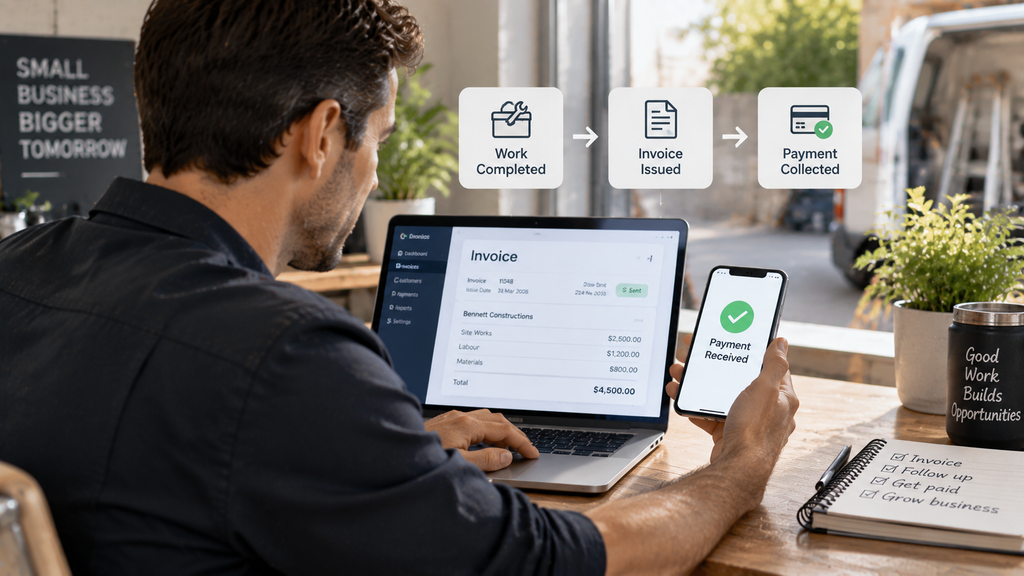
1. Invoice Customers as Soon as the Work Is Completed
One of the simplest ways to improve cash flow is to invoice promptly.
Every day between completing work and issuing an invoice can delay payment. Instead of waiting until the end of the week or month, consider making invoicing part of your normal job completion process.
Work completed → Invoice issued → Payment collected
Faster invoicing can help reduce the gap between money going out and money coming into the business.
2. Review Your Payment Terms
Payment terms have a significant impact on cash flow. If your business currently offers 30-day terms, consider whether shorter terms are appropriate for your industry and customers.
Depending on your business, options could include:
- 7-day or 14-day payment terms
- payment on completion
- deposits before work begins
- progress payments
- recurring direct debit arrangements.
Shorter terms do not guarantee faster payment, but they establish clearer expectations about when payment is due.
3. Make It Easy for Customers to Pay
The more difficult it is for customers to pay, the easier it is for invoices to remain outstanding.
Consider offering convenient options such as:
- EFT or bank transfer
- credit or debit card
- direct debit
- online payment links
- recurring payment arrangements.
Automated reminders, including a reminder shortly before an invoice falls due, can also encourage customers to pay on time.
Cash Flow Tip
Review your invoices from the customer’s perspective. Can they immediately see:
- how much they owe?
- when payment is due?
- how they can pay?
- where payment should be sent?
- what happens if payment is late?
If any of these are unclear, improving your invoicing process may help accelerate collections.
4. Have a System for Following Up Overdue Invoices
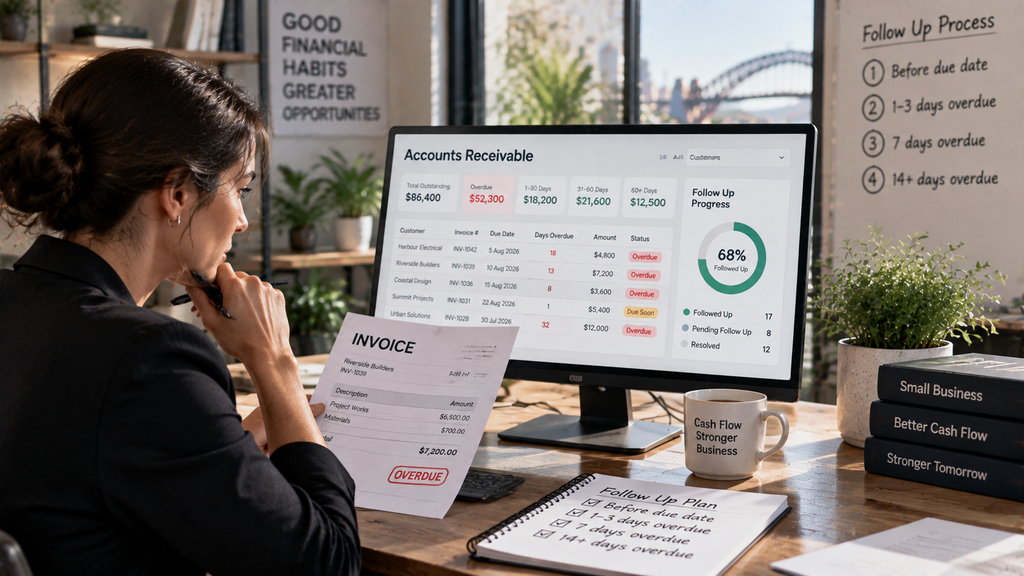
Late payments are a common cause of small business cash flow problems. Often, the issue is not that customers refuse to pay, but that there is no consistent process for following up outstanding invoices.
A simple process could be:
Before due date: Automated reminder
1–3 days overdue: Friendly reminder
7 days overdue: Email or phone follow-up
14+ days overdue: Formal notice or escalation
The exact process will depend on your business, but consistency is important.
Regularly review your accounts receivable ageing report so you know how much money is outstanding and how long customers have owed it.
5. Ask for Deposits and Progress Payments
For businesses undertaking large projects, waiting until completion before receiving payment can place unnecessary pressure on cash flow.
You may have already paid for wages, materials, subcontractors, equipment, travel and other overheads. Where appropriate, consider requesting a deposit or using staged payments.
For example:
30% deposit → 40% progress payment → 30% final payment
This can help align cash receipts with the costs of delivering the project.
6. Identify Customers Who Consistently Pay Late
Not every customer has the same payment behaviour. A customer with 30-day terms may regularly take 60 or 75 days to pay.
That distinction matters when preparing a cash flow forecast. If a customer consistently pays late, consider requesting a deposit, shortening payment terms, requiring progress payments, limiting credit or reflecting their actual payment behaviour in your forecast.
The key is to manage cash flow based on reality rather than assumptions.
7. Review Your Pricing When Costs Increase
Regularly reviewing pricing is an important but often overlooked cash flow strategy.
If wages, supplier costs, rent, insurance, software, superannuation or financing costs increase while your prices remain unchanged, your profit margin can gradually disappear.
A business can be busy and still become financially weaker. Regular pricing reviews help ensure prices continue to reflect the actual cost of delivering your products or services. Even a modest price increase across a large customer base can improve profitability and cash flow.

8. Don’t Let Excess Stock Tie Up Your Cash
For retail, wholesale, manufacturing and other inventory-based businesses, stock can represent a significant amount of money sitting on shelves.
The more cash tied up in inventory, the less available for wages, suppliers, tax, superannuation, loan repayments and business opportunities.
Regularly identify fast-moving, slow-moving, obsolete, excess and seasonal stock. Reducing unnecessary purchases or clearing slow-moving inventory may free up cash, while still maintaining enough stock to service customers.
9. Put Money Aside for GST, Tax and Superannuation
One of the biggest cash flow mistakes is treating money collected for tax obligations as available working capital.
GST collected from customers, for example, may temporarily sit in the business bank account but will ultimately be required to meet GST obligations.
Businesses should also plan for:
- PAYG withholding
- GST
- income tax
- superannuation
- payroll-related obligations.
A practical strategy is to maintain a separate tax or obligations account and regularly transfer an appropriate amount into it. This can reduce the risk of reaching BAS or tax payment time without enough cash available.
10. Understand Why Your Profit Doesn’t Always Match Your Bank Balance
A business can be profitable and still experience cash flow problems because accrual accounting and cash accounting measure different things.
Under accrual accounting, revenue may be recognised when an invoice is issued even though the customer has not paid.
For example, you issue a $50,000 invoice. Your profit and loss statement may recognise the revenue, but your bank balance does not increase until the customer actually pays. Meanwhile, the business may already have paid wages and suppliers.
Business owners should therefore monitor both:
Profitability – Is the business making money?
Cash flow – Is there enough cash available to meet upcoming obligations?
They are related, but they are not the same thing.
11. Prepare a 4, 8 or 13-Week Cash Flow Forecast
A cash flow forecast provides a forward-looking view of expected money coming into and going out of the business.
Expected cash coming in may include customer payments, deposits, loans and other income.
Expected cash going out may include:
- wages and superannuation
- suppliers
- rent
- GST and PAYG withholding
- tax
- loan repayments
- software and subscriptions
- other operating expenses.
A weekly forecast can identify potential shortages before they happen. If your forecast shows a $20,000 shortfall several weeks ahead, you have time to investigate options rather than discovering the problem on payday.

12. Keep Your Bookkeeping Up to Date
You cannot effectively manage cash flow using financial information that is weeks or months old.
Regular bookkeeping provides better visibility over:
- cash at bank
- unpaid and overdue invoices
- supplier bills
- payroll
- GST and PAYG withholding
- business expenses
- profitability.
Keeping records current also makes BAS preparation easier and helps identify financial problems earlier. Cloud accounting and automated bank feeds can make regular bookkeeping more efficient.
The objective is not simply accurate tax records. Your financial information should help you make better business decisions.
13. Prepare for Payday Super
Payday Super commenced from 1 July 2026, changing the timing of superannuation payments for employers.
Under the new system, employers are required to pay superannuation at the same time as salary and wages, with contributions reaching employees’ super funds within the applicable timeframe. Superannuation therefore needs to be incorporated into regular payroll cash flow planning, rather than being treated simply as a quarterly cash flow event.
What Small Business Owners Should Review
Check that:
- your payroll software is configured for Payday Super
- superannuation calculations are correct
- sufficient cash is available on payday
- your clearing house or payment system is working correctly
- employee super fund details are accurate
- payroll and bookkeeping processes are up to date.
For businesses with tight cash flow, more frequent superannuation payments make accurate forecasting particularly important.
Cash Flow and Wages: Why Planning Matters
For businesses with employees, wages are generally one of the largest recurring expenses. This makes payroll relatively easy to forecast when financial information is accurate.
A business should know:
- How much will payroll cost?
- When will it be paid?
- How much superannuation will be required?
- What tax and other payroll obligations are due?
- How much cash will remain afterwards?
A rolling cash flow forecast helps answer the more useful question:
“Will there be enough cash in four, eight or thirteen weeks?”
Rather than simply asking whether there is enough money in the bank today, business owners can identify potential problems early and take action.

Conclusion: Better Cash Flow Starts With Better Financial Visibility
Cash flow management is not about keeping a huge amount of money sitting in the bank. It is about knowing when money is coming in, when it needs to go out and identifying potential shortages before they become problems.
Getting invoices out quickly, following up overdue debts, reviewing pricing, managing inventory, separating tax obligations, keeping bookkeeping current and preparing regular cash flow forecasts can all improve financial certainty.
With Payday Super changing the timing of superannuation payments, businesses with employees also need to include superannuation in their regular payroll and cash flow planning.
If your business is profitable but regularly feels short of cash, consider speaking with your accountant or bookkeeper. Reviewing your cash flow forecast, debtor collection process, pricing, margins, expenses and upcoming tax and payroll obligations can help identify where improvements could have the greatest impact.
Frequently Asked Questions About Small Business Cash Flow
What is cash flow management for a small business?
Cash flow management involves monitoring the money coming into and leaving your business and ensuring sufficient cash is available to meet upcoming obligations such as wages, suppliers, tax, loans and superannuation.
How can I improve cash flow quickly?
Start by invoicing customers promptly, following up overdue accounts, reviewing payment terms, requesting deposits or progress payments and identifying unnecessary or poorly timed expenses.
Why is my business profitable but short of cash?
Profit and cash flow are different. A business may record revenue when an invoice is issued but not receive the cash until weeks later. At the same time, wages, suppliers and other expenses may need to be paid immediately.
How often should a small business prepare a cash flow forecast?
A weekly rolling cash flow forecast can be particularly useful for businesses with employees or tight cash flow. Many businesses use a 4-, 8- or 13-week forecast to identify upcoming cash pressure.
How does Payday Super affect small business cash flow?
From 1 July 2026, employers need to incorporate superannuation payments into their regular payroll cash flow planning. Superannuation is no longer simply a quarterly payment that can be treated separately from the normal payroll cycle.
Should I keep money aside for GST and tax?
Yes. Setting aside money progressively for GST, PAYG withholding, income tax and other obligations can help prevent a large tax bill from creating an unexpected cash flow problem.
When should a business owner seek help with cash flow?
If your business is profitable but regularly struggles to pay wages, suppliers or tax obligations, or if you are relying on overdrafts or credit to cover regular expenses, it is worth speaking with your accountant or bookkeeper before the situation becomes more serious.
General Information Disclaimer
The material on this page and on this website has been prepared for general information purposes only and not as specific advice to any person. Any advice contained on this page and on this website is General Advice and does not consider any person’s particular investment objectives, financial situation and particular needs.
Before making an investment decision based on this advice you should consider, with or without the assistance of a securities adviser, whether it is appropriate to your particular investment needs, objectives and financial circumstances. In addition, the examples provided on this page and on this website are for illustrative purposes only.
Although every effort has been made to verify the accuracy of the information contained on this page and on this website, Camden Professionals and/or Investax Group, its officers, representatives, employees, and agents disclaim all liability (except for any liability which by law cannot be excluded), for any error, inaccuracy in, or omission from the information contained in this website or any loss or damage suffered by any person directly or indirectly through relying on this information.
Cashflow management for tradies and small business owners
Managing money is crucial for any business to do well and keep going strong. But for construction and trade businesses, it’s even more critical. Why? Because they deal with some tricky situations. They might get paid in big chunks for projects, but they also have to handle lots of costs that can change. Plus, they often must wait a long time to get paid, and projects might not always finish when expected. And they need to have a good amount of cash ready to buy materials and pay workers.
Sound familiar? Don’t worry! In this article, we’ll talk about some important ways to handle cash flow smartly, especially for construction and trade businesses.
Cash Flow Management Tip 1: Accurate Financial Forecasting
To manage your cash flow well, start by making sure you have a good idea of how much money will be coming in and going out. This means predicting your future earnings and expenses, considering things like when you’ll get paid for projects and any seasonal changes in your business. You can use accounting software or get advice from experts to help you make realistic predictions.
At Camden Professionals, we’ve assisted many small business owners and tradies with this exact issue. By helping them create accurate financial forecasts for each project, they could plan their spending better and use their resources wisely.
This meant they didn’t stretch themselves too thin by taking on too many projects at once, and they could put their money where it mattered most. This approach boosted their profits and reduced the need for costly short-term loans when they faced tough times with cash flow.
Cash Flow Management Tip 2: Streamline Invoicing and Payment Processes
Good bookkeeping is super important for tradies and construction companies. Efficient invoicing and payment processes can help deliver positive cash flow. Send out invoices promptly and follow up on overdue payments diligently. Consider offering incentives for early payments or accepting online payments to speed up the collection process.
Cash Flow Management Tip 3: Manage Inventory Efficiently
If you’re serious about the growth of your business, you need systems that support it both in the short and long-term. Believe it or not, we often hear from businesses that operate at a loss because they have no visibility on the true costs associated with the manufacturing, storing or shipping of their products. Or, they’re wasting time manually processing orders and using Excel to keep track of stock. Lost orders and slow deliveries ultimately mean a less-than-ideal customer experience.
Cash Flow Management Tip 4: Invest in Project Management and Accounting Software
Good business systems can streamline many aspects of construction and trades businesses. Consider investing in project management software such as like Xero, and mobile apps that can be used on site to improve efficiency, reduce errors, and save time.
We helped a contracting client implement project management software and accounting tools to streamline their operations. By doing so, they improved project planning, monitoring, and cost tracking. This led to fewer costly errors and rework, and they were able to complete projects ahead of schedule, accelerating cash inflow. They could also manage multiple projects simultaneously with greater precision, leading to improved profitability and consistent cash flow.
How Cash Flow Forecasting Helps Your Business
- Planning for Surpluses and Shortfalls. By carefully analysing your income and spending, you can predict times when you might have extra cash or fall short. This helps you make smart choices about saving, investing, or cutting costs. If you’re hiring more people, a cash flow forecast can guide you on when it’s best to expand your team.
- Negotiating Payment Terms. With cash flow forecasts, you can negotiate better payment terms with suppliers, clients, or lenders. Knowing what’s coming in and going out lets you secure terms that match your financial situation, making operations smoother and improving relationships.
- Predicting Taxes and Obligations. Tax time can be stressful, but with a cash flow forecast, you can plan for your tax payments ahead of time. This prevents surprises and lets you set aside money for taxes efficiently, avoiding penalties.
- Making Growth Decisions. Thinking about expanding or taking on new projects? A cash flow forecast helps you see if you have the money to do it and if the timing is right for your business to grow smoothly.
- Impress Lenders and Investors. When you’re looking for funding or reporting to shareholders, a cash flow forecast shows that you’re financially savvy and have a handle on your business’s future potential.
- Smart Inventory Management. Forecasting cash flow helps you avoid stocking too much or too little inventory. This means you can balance inventory costs while keeping your customers happy with what they need.
- Achieving Personal Goals. If your goal is to create financial security for yourself and your family through your business, a cash flow forecast can help you unlock the cash and profits you need to make that happen. It connects your business’s wealth with your personal goals for a brighter financial future.
Cash flow management is the lifeblood of construction and trades businesses. By taking action in the areas we discussed and staying proactive in your financial planning and monitoring, you’ll build a healthier bottom line and increase opportunities for growth. Remember that cash flow management is an ongoing process that requires attention and adjustment as your business evolves.
How can we help?
If you have any questions or would like further information, please feel free to give our office on 08 9221 5522 or via email – info@camdenprofessionals.com.au or arrange a time for a meeting so we can discuss your requirements in more detail.
General Advice Warning
The material on this page and on this website has been prepared for general information purposes only and not as specific advice to any particular person. Any advice contained on this page and on this website is General Advice and does not take into account any person’s particular investment objectives, financial situation and particular needs.
Before making an investment decision based on this advice you should consider, with or without the assistance of a securities adviser, whether it is appropriate to your particular investment needs, objectives and financial circumstances. In addition, the examples provided on this page and on this website are for illustrative purposes only.
Although every effort has been made to verify the accuracy of the information contained on this page and on this website, Camden Professionals, its officers, representatives, employees, and agents disclaim all liability [except for any liability which by law cannot be excluded), for any error, inaccuracy in, or omission from the information contained in this website or any loss or damage suffered by any person directly or indirectly through relying on this information.